White Label Web Design: Scale Delivery Without Hiring
By Cameron Kirdzik — Founder @WebHunt.ai
· 8 min read
TL;DR
- AI flipped the equation: keep simple brochure builds in-house; white-label only complex or time-compressed projects.
- Use a 6-flag complexity score and deadline threshold to decide in minutes.
- Know your P&L: brochure in-house margins ~86–92%; white-label complex builds still net ~42–54%.
- Vet partners on portfolio patterns, SLAs, stack compatibility, QA artifacts, and measurable references.
- Ship with a strict 10-point QA and attach MRR (care/SEO) to every launch.
White Label Web Design in the AI Era: What Actually Belongs Outsourced Now
White label web design means you sell and own the client relationship while a third-party partner builds under your brand. You control strategy, QA, and the delivery timeline; they handle implementation.
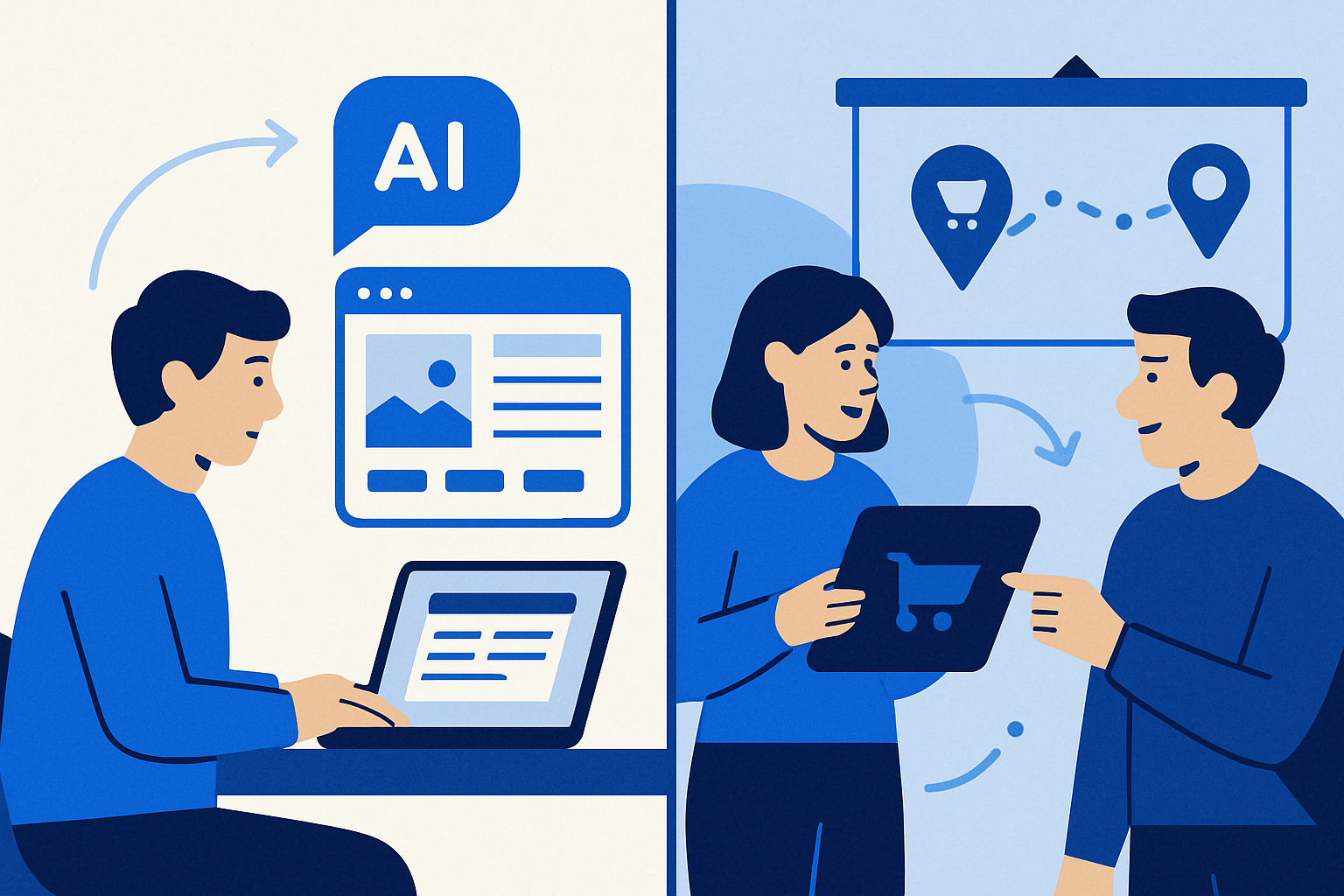
Here’s the update that matters in 2026: simple brochure/microsites (1–5 pages, lead forms, basic CMS) are now cheaper and faster to build in-house with Replit, Lovable, Base44, v0, Bolt, Framer AI, Cursor, Windsurf, or Claude Design—often same day. Offloading those erodes your margin without adding speed.
Where white-label partners still earn their place:
- E‑commerce with >50 SKUs or custom checkout/discount logic
- Subscription/booking logic, memberships, or gated content
- Multi-location sites with store locator + scalable location pages
- Custom integrations/APIs (CRM, POS, scheduling)
- Multi-language SEO with hreflang and translation workflow
- Accessibility at scale with documented audits
Decision guardrail: If the job needs net-new custom functionality your AI stack can’t reliably generate and maintain in 24–72 hours, it’s a white-label candidate. If not, ship it in-house and keep the margin.
AI compression is the backdrop: build costs and timelines for simple sites are down ~90–95%, so your bottleneck isn’t production—it’s prospecting and closing.1
Key takeaway: Default to in-house AI builds. Only escalate to white-label for complex, multi-module work—or when timelines collide with capacity.
If you want a head start on sourcing the right prospects for either path, WebHunt.ai can surface local businesses with weak or missing sites and score their buy-likelihood so your pipeline feeds both simple in-house wins and complex white-label candidates.
Build vs. Buy: A Fast Decision Framework You Can Teach Your PMs
Flag complexity fast with six binary checks:
- E‑commerce complexity: SKU count > 50 or custom checkout
- Integrations: CRM, POS, or scheduling API beyond native apps
- Multi-location: >5 locations needing locator + templated pages
- Custom data models: directories, listings, or structured repositories
- Regulated accessibility: WCAG 2.1 AA with audits and remediation
- Multi-language: hreflang plus translation workflow and QA
Scoring rule:
- 0–1 flags = build in-house with AI
- 2–3 flags = hybrid (you scaffold with AI, partner handles complex modules)
- 4–6 flags = white-label full build
Turnaround threshold:
- If client deadline <7 days and complexity ≥2 flags, use your partner bench to de-risk capacity.
- If deadline ≥7 days, prototype in-house first (homepage + 1 key template) to clarify scope and confirm feasibility; then decide.
Ops heuristic: If the SOW requires more than 2 hours of manual QA per 10 pages for accessibility or schema, escalate to a white-label specialist.
Prototype-first workflow:
- Day 1: Generate a homepage and one key inner page via AI (e.g., Framer AI or Replit) to align on direction.
- Use that artifact to anchor scope, cut revision loops, and hand your partner a concrete target.
For faster scoping, WebHunt.ai can produce AI opportunity briefs on specific leads, including audits and suggested pitch angles—useful for deciding whether a prospect smells like a complex (white-label) build. If you proceed, the one-click website prompt in WebHunt.ai pre-fills an AI builder prompt with the business’s real details so you can produce that Day 1 prototype immediately.
Margin Math: Pricing Ladders, Target COGS, and When Outsourcing Breaks
Baseline packaging (example bands; adapt to your market):
- Starter (3–5 pages, lead-gen): Price $1,000–$1,800; target COGS $80–$200
- Growth (8–15 pages, local SEO bundle): Price $2,000–$3,800; target COGS $300–$700
- Complex (e‑comm/multi-location/custom): Price $4,500–$12,000; target COGS 40–60% depending on complexity
P&L example — In-house brochure build
- Price: $1,500
- Tooling COGS: $30 (hosting/theme/apps/AI credits)
- Labor: 2–4 hours PM/QA at $40/hr = $80–$160 (delivery is AI-assisted)
- Net delivery margin: ≈ $1,310–$1,390 (86–92%)
P&L example — White-label brochure build (don’t do this)
- Price: $1,500
- Partner fee: $700
- PM/QA: $150
- Net margin: ≈ $650 (43%) — often slower and worse margin than in-house
P&L example — White-label complex build (where partners shine)
- Price: $6,500
- Partner fee: $2,500–$3,200
- PM/QA: $400
- Net margin: ≈ $2,900–$3,600 (42–54%) with lower risk and higher client value
Attach ongoing MRR to every launch:
- Hosting/care: $99–$249/mo
- Local SEO/GBP/content: $300–$1,500/mo
- Payment processing affiliate or rev-share (where applicable) to lift LTV2
Red flags that kill margin:
- Unlimited revisions in the SOW
- Content-writing included without page caps/word counts
- Custom integration scope without paid discovery
- Reactive scope changes after dev kicks off (no change-order discipline)
By the numbers: In-house AI brochure builds can net ~90% delivery margin; complex white-labeled builds can still clear ~50%—if your SOW and QA keep revisions tight.
Vetting White-Label Partners: A 9-Point Due Diligence Checklist
- Portfolio match: Require 3 live URLs per pattern you’ll outsource (e‑comm, locator, memberships). Get stack details and clarity on who maintains what post-launch.
- SLAs and capacity: Written SLAs for first draft, revision cycles, and bug fixes; confirm surge capacity (how many concurrent projects at your average scope?).
- Stack compatibility: Can they start from your AI prototype or prompt? Can they maintain code generated by Replit, Bolt, or v0 without full refactors? This is non-negotiable.
- QA artifacts: Ask for sample test plans, Lighthouse reports, and accessibility audit samples (axe/WAVE outputs) from past work.
- Security/compliance: Data handling, backups, PII, GDPR/CCPA readiness, and how they vet their own subs.
- Transparency on subcontractors: Do they white-label further? Require your approval for any downstream subs.
- Financials and pricing: Rate card, rush fees, change-order process; negotiate volume discounts or points bundles.
- References with metrics: Ask for average on-time delivery %, revision count per project, and post-launch defect rate over the last 12 months (defect rate is a standard quality metric for production).3
- Pilot project: Start with a paid test (≤$1,000 scope) to validate workflow, comms velocity, and QA before committing larger projects.
If you’re building a bench while filling pipeline, WebHunt.ai can keep your calendar fed via its human cold-calling marketplace or AI Voice Agent SDR, so you’re trialing partners with real opportunities instead of waiting for the “perfect” lead.
SOW and Handoff: Exactly What to Give Your Partner to Avoid Rework
- Scope doc: Page inventory, content responsibilities (who writes what, word counts), media sources, and approved components/patterns.
- Design system: Tokens (color, type, spacing), core components (header, footer, cards), interaction rules, brand assets, and Figma or AI-generated prototypes.
- Technical specs: CMS choice, plugin/app constraints, required integrations with endpoints and success criteria, sitemap and URL structure, schema requirements, and performance budgets (LCP/CLS targets).
- Content kit: Client-provided copy/images and clearly labeled AI placeholders; document media licensing status.
- SEO kit: Target keywords, on-page templates, internal link map, location page generator spec, and hreflang rules if multilingual.
- Milestones: Dates for prototype, dev complete, QA window, client review, and launch; acceptance criteria per milestone; change-order trigger rules.
- Revision policy: Cap on rounds (e.g., 2 rounds ≤ 10 comments each), turnaround expectations both ways, and explicit costs for scope changes.
Pro tip: send your partner your AI prototype plus the one-click prompt you used. Many partners can run with it and avoid rework—and you remain the creative lead.
10-Point QA Checklist Before Client Handoff (Copy This Into Your PM Tool)
- Performance: LCP ≤ 2.5s on 4G throttling and CLS < 0.1 across top-5 templates; attach page-speed report.
- Mobile and cross-browser: Responsive checks on iPhone/Android; Chrome/Safari/Firefox/Edge (latest-2). Verify nav, tap targets, and sticky elements.
- Accessibility: Automated axe scan with 0 criticals, semantic landmarks, alt text complete, visible focus states, no keyboard traps; color contrast meets AA.
- SEO basics: Unique title/H1/meta, clean slugs, canonical tags, XML sitemap, robots.txt, and schema per template (LocalBusiness, Product, FAQ, Article).
- Content completeness: All placeholders replaced, 404 and thank-you pages branded, forms with success states and validation messages.
- Tracking and pixels: GA4 installed, GSC verified, conversions tracked (form submits/calls/checkout), consent banner if required.
- Integrations: CRM/booking tools pass required fields, webhooks fire and log, payment gateway test transactions succeed.
- Security/infra: HTTPS valid cert, HSTS enabled, admin users audited with MFA, backups configured, staging locked.
- Legal: Privacy/terms/cookie policy linked; ADA statement if needed; licensed fonts/images documented.
- Launch checklist: Pre/post DNS steps, cache purge, 24–72 hour post-launch bug window agreed, rollback plan documented.
Drop this list into your PM tool verbatim. Make acceptance criteria in your SOW reference these points.
Sell the Client, Subcontract the Build: Messaging, Promises, and Risk Control
Message the value: You provide strategy, speed, and accountability. A specialized build crew handles complex implementation under your standards. You remain responsible for results.
Set credible AI-era promises:
- Same-week homepage prototype using AI tools
- Fixed-fee delivery with capped revisions
- Optional “try-before-you-commit” preview for simple scopes (then apply the fee to the build)
De-risking talk track: Explain the QA process, performance targets, and a warranty window (e.g., 10 business days for defect remediation). Share two anonymized case studies with timeline and KPIs (traffic lift, conversion rate).
Objection handling: “Why not go direct to a dev shop?” Because you align incentives, own the UX/SEO strategy, and guarantee accountability. Your partner model gives bench capacity without client risk.
Contract language to protect you: Non-solicit and data ownership, acceptance criteria tied to the QA checklist, explicit change-order triggers, and a 10-business-day remediation clause.
If you need more at-bats to prove this pitch, WebHunt.ai can enrich owners’ direct contact info (name, phone, email with confidence scoring) so you’re talking to the real decision-maker—pair that with a same-day prototype and you’ll close faster.
Scale Systems: Pipeline, Forecasting, and a Repeatable White-Label Motion
Forecasting: Build a 12-week capacity model with swimlanes for in-house vs. partner hours. Tag projects by the six complexity flags to predict bench usage and prevent bottlenecks.
Lead mix: Maintain a 70/30 split of simple vs. complex leads. The simple ones feed your high-margin in-house revenue; the complex ones keep your white-label bench profitable and warm.
Pre-sales accelerators: Generate a same-day AI mock (homepage + 1 inner) to lift close rates and compress discovery on both paths. Use it as the artifact that your partner scales, not recreates.
Handoffs at scale: Templatize SOWs, QA scripts, and revision policies. Use a single intake form for partners to request clarifications to cut Slack/Email noise.
Post-launch MRR machine: Attach care plans, GBP/SEO, and content packages to every white-label project. Set renewal reminders and upsell triggers based on site health and review momentum.
To feed this machine without adding SDR headcount, tap WebHunt.ai for a scored lead database filtered by trade/city and weakness signals, then manage deals through its pipeline/workflow (and API/Zapier) so nothing leaks. It’s purpose-built for AI-native builders who ship in hours and scale by processing more qualified leads, not by hiring more devs.
Frequently asked questions
What is white label web design and how is it different from outsourcing?
White label web design is a specific kind of outsourcing where your partner builds under your brand. You remain the client’s point of contact and control strategy, QA, and launch. Generic outsourcing often exposes the third party directly to the client and dilutes your brand and accountability.
Which types of projects should I keep in-house vs. send to a white-label partner in 2026?
Keep 1–5 page brochure sites and straightforward lead-gen builds in-house using AI tools; they’re faster and higher margin. White-label e‑commerce (>50 SKUs), multi-location sites, custom integrations/APIs, memberships, regulated accessibility, and multi-language SEO—or any project your AI stack can’t ship reliably within 24–72 hours.
How do I price white-labeled work without destroying my margins?
Use a packaging ladder (Starter, Growth, Complex) and target COGS bands. For simple builds, in-house delivery often nets ~86–92% margin; white-label those only when time-constrained. For complex builds priced $4.5k–$12k, a partner fee at 40–60% COGS still leaves healthy margins with lower risk. Always cap revisions and separate paid discovery for custom integrations.
What should be in my white-label SOW to avoid scope creep?
Include page inventory, content responsibilities with word counts, design system and prototypes, technical specs (CMS, integrations, schema, performance budgets), SEO kit, clear milestones with acceptance criteria, and a strict revision policy. Tie acceptance to a concrete QA checklist to prevent open-ended changes.
How do I maintain quality control if I’m not doing the build myself?
Run a prototype-first approach, require QA artifacts from partners, and enforce a 10-point QA checklist before client handoff. Use SLAs for drafts, revisions, and bug windows, and measure on-time delivery, revision counts, and post-launch defect rate. Start with a small paid pilot to validate the workflow.
Can I still promise fast timelines if a partner is doing the work?
Yes—anchor the sale on a same-week AI prototype you produce in-house, then hand implementation to your partner with fixed milestones and a defined QA window. Your client experiences speed and clarity while your bench absorbs the heavy lift.
Sources
About the author
Cameron Kirdzik — Founder @WebHunt.ai
Cameron is the founder of WebHunt.ai, where he helps web designers, agencies, and freelancers find local businesses that need a website. He writes practical, field-tested guides on prospecting and closing local clients.