Website ROI for Small Business: The One-Job Math + Worksheets
By Cameron Kirdzik — Founder @WebHunt.ai
· 8 min read
TL;DR
- Pitch the one-job story: one extra booking a month often covers an AI-era site in weeks.
- Use profit, not revenue: Payback months = Site Cost ÷ (Avg Job Profit × Added Jobs/Month).
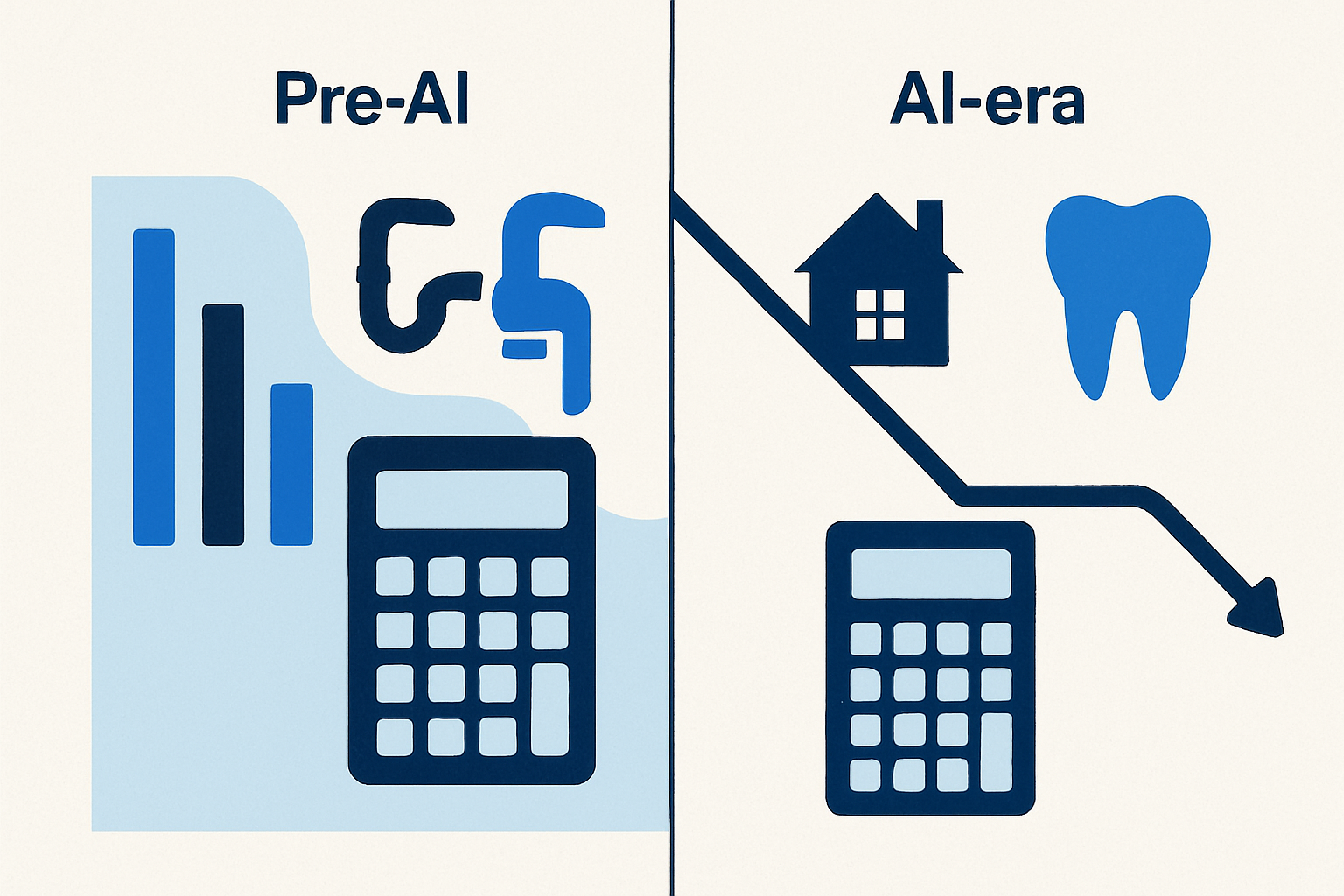
- Show two columns in proposals: Pre-AI $1.5k–$3k vs AI-era $400–$600 for immediate credibility.
- Plug in trade numbers live; if the owner won’t share, use conservative defaults and LTV where relevant.
- Ship conversion basics day one (click-to-call, booking, reviews, speed) to shorten payback.
The one-job math: turn skepticism into a 60-second ROI story
Open with this question: If your website helps you land just one extra job a month, does it pay for itself?
In the AI era, the answer is usually yes — fast. AI-built brochure sites commonly cost $400–$600 and go live in hours, not weeks. Pre‑AI, comparable sites were $1,500–$3,000 with multi‑week timelines. That shift compresses payback from months to weeks.
Use one formula and stick to it:
- Payback (months) = Site Cost ÷ (Average Job Profit × Added Jobs/Month)
Use profit, not revenue. If the average job is $400 revenue at a 50% gross margin, profit per job is $200. One extra job per month adds $200/month profit. That pays back a $400–$600 site in ~2–3 months; add two jobs and you’re at ~1 month.
Commit to showing two columns in every example — Pre‑AI vs AI‑era — so the shorter payback is undeniable.
Key takeaway: Don’t debate “do websites work?” Run the numbers with their ticket size and margin. One more booking per month is usually enough.
The 3-number ROI worksheet you can print into any proposal
Collect three numbers live while you talk:
- Average ticket value (or first‑year customer value for repeat services)
- Rough gross margin percentage
- Realistic added bookings per month from a basic site (start with +1)
Worksheet spec (two columns, you fill the blanks live):
- Pre‑AI cost: $1,500–$3,000
- AI‑era cost: $400–$600
- Rows: Average Ticket, Margin %, Profit/Job, Added Jobs/Month, Monthly Profit Added, Payback (months), 12‑Month ROI (%)
Defaults when the owner won’t share:
- Margin: 40–60% for home services; 30–50% for trades with higher material share
- Added bookings/month: start at +1 for a skeptical baseline; if they’ll accept online booking and click‑to‑call, revisit +2–3
Worked micro‑example:
- Ticket = $450, Margin = 50% → Profit/Job = $225
- Added Jobs/Month = 1 → Monthly Profit Added = $225
- Payback: Pre‑AI $2,500 ÷ $225 ≈ 11.1 months; AI‑era $500 ÷ $225 ≈ 2.2 months
Instruction for proposals: print this as a one‑page insert with blanks and two clear columns (Pre‑AI vs AI‑era). Fill it in live on Zoom or speakerphone.
Trade-by-trade ROI: plug-and-play examples for common locals
Plumber
- Typical ticket: $350–$500; many jobs are same‑day and phone‑first1.
- Example (AI‑era): $500 site, $425 avg ticket, 50% margin, +1 job/mo → $212.50/mo profit → payback ≈ 2.4 months; +2 jobs/mo → ≈ 1.2 months1.
HVAC
- Seasonal spikes; service call values around $150–$300; maintenance plans increase long‑term value2.
- Example: $500 site, $250 ticket, 45% margin, +2 calls/mo → $225/mo profit → payback ≈ 2.2 months2.
Roofer
- High lead value; roof replacements often $9,000–$12,0003.
- Example: $500 site, $10,000 job, 30% margin, +1 job/6 months (0.17/mo) → $500/mo profit → payback ≈ 1 month from a single close3.
Electrician
- Typical residential job $150–$4004.
- Example: $500 site, $300 ticket, 50% margin, +2 jobs/mo → $300/mo profit → payback ≈ 1.7 months4.
Dentist
- First‑year patient value often $500–$1,000; lifetime commonly $5,000–$10,000 including hygiene, restorative, and cosmetics5.
- Example: $600 site, $800 first‑year value, 40% margin, +2 new patients/mo → $640/mo profit → payback < 1 month5.
How to localize these: swap the average ticket for your city’s actuals from recent invoices. Keep margins conservative. Start at +1 job/month if the owner is skeptical, and re‑model +2–3 once booking and reviews are in place.
By the numbers: In most service trades, +1 job/month is enough to retire a $400–$600 site cost in weeks, not quarters.
LTV math: when one booking becomes years of revenue
Use lifetime value when repeat is normal — dental hygiene recall, lawn care, pest control, auto maintenance, med spa memberships. The formula is the same; just swap in first‑year profit or multi‑year profit to frame upside.
Worked example (pest control):
- Initial service $200, quarterly $125 × 3 = $375 → annual revenue ≈ $575
- Margin 45% → ≈ $259 yearly profit per customer
- +2 customers/mo → ≈ $518/mo profit
- AI‑era $500 site → ≈ 1‑month payback
Worked example (auto shop):
- Average repair order (ARO) $350, ~2.5 visits/year → ≈ $875 year‑one revenue
- 40% margin → ≈ $350 yearly profit
- +3 customers/mo → ≈ $1,050/mo profit → payback < 1 month
Pitch script:
- “Even if your website only wins one new repeat customer a month, the first year alone covers the site; years 2–5 are pure upside.”
Proposal note: if you model LTV, show both first‑year ROI and 3‑year ROI lines in the worksheet.
Conversion boosters that shorten payback (and are fast to ship now)
What to add on day one:
- Click‑to‑call buttons in the header and sticky on mobile
- Online booking or a friction‑light request form
- Map + hours + service area
- Trust drivers: Google rating, real photos, short testimonials
- 3–5 recent project photos with captions
Speed matters. Mobile visitors won’t wait; keep core pages fast and clear. Prominent booking and phone buttons typically lift completions, especially on mobile, when they’re placed above the fold and repeated after service descriptions. In the AI era you can also promise speed‑to‑live:
- “We’ll launch the core site in 24–48 hours, then A/B test the call‑to‑action and booking position for two weeks.”
Tooling to make that real: Framer AI, v0, Lovable, or Bolt for a same‑day draft; ship call tracking and basic page‑speed fixes in the first sprint.
Objection handling with numbers, not debate
“We’re busy already.”
- Capacity check: If they can absorb +1 job/week, the site is a low‑risk margin lever. If not, angle the site toward higher‑ticket services and use booking controls to cap volume.
“We get referrals.”
- Great — make them Googleable. Buyers still search “brand + city” and expect a fast, credible site with services, pricing signals, and a phone button. Referrals convert better when the website confirms trust.
“Facebook page is enough.”
- Most shoppers still expect a website with a services list, proof points, and easy contact. Social pages don’t replace a clear offer, FAQs, and structured service info.
“We tried a site before, it didn’t work.”
- Reframe: basic conversion stack + speed‑to‑live. Offer a low‑risk trial — stand up a no‑commitment draft, forward a tracking number, and measure qualified calls/forms for 14–30 days. Owner pays only if at least X qualified inquiries arrive.
If you want to add a light outbound assist during that trial, the AI Voice Agent SDR from WebHunt.ai can call warm prospects you select, pitch the refreshed site, and book meetings onto your calendar — helpful when owners doubt demand but have some prior inquiries.
Drop-in proposal insert: dual-cost ROI worksheet (printable framing)
Layout spec (one page):
- Header: Business name, city, contact
- Two side‑by‑side columns labeled:
- Pre‑AI ($1,500–$3,000)
- AI‑era ($400–$600)
- Lines to fill:
- Average Ticket (or First‑Year Value)
- Margin %
- Profit/Job (Ticket × Margin)
- Added Jobs/Month
- Monthly Profit Added (Profit/Job × Added Jobs)
- Payback (months)
- 12‑Month ROI (%)
- Checkbox row: Conversion Boosters included — click‑to‑call, online booking, reviews widget, speed pass — to justify the Added Jobs assumption
- Notes: “Assumes conservative +1 job/mo. If +2–3 jobs/mo after reviews + booking, payback shortens to weeks.”
- Signature block: “Proceed to draft” with 7‑day validity and a simple guarantee (e.g., cancel if fewer than X inquiries in 30 days)
Export guidance: deliver it as a large‑type PDF you can fill live. Keep math visible, assumptions in plain English.
Find the right owners and show them the math in minutes
Prioritize trades with fast payback: plumbers, electricians, HVAC, pest control, roofers, dental — where one extra booking per month usually covers an AI‑era site quickly.
Target signals of upside: missing site, no HTTPS, slow pages, outdated design, no online booking, and weak review momentum. These correlate with underperforming inbound — and short payback once fixed.
Fast demo flow:
- Pull 3–5 leads in a single metro and niche.
- Generate a same‑day draft site with their real details.
- Attach the filled ROI worksheet to your first email or call.
If you’d rather not build the target list by hand, WebHunt.ai scores tens of thousands of local businesses for buy‑likelihood using website quality, review momentum, and category demand. Filter by trade and city, then sort by the weakest sites to maximize quick wins.
To speed prep, open a lead’s Deep Analysis in WebHunt.ai. The AI opportunity brief audits the current site, shows screenshots, and suggests a concrete pitch angle you can pair with your ROI math.
When you’re ready to show rather than tell, the one‑click website prompt from WebHunt.ai generates a ready‑to‑paste prompt for builders like Framer AI, v0, Lovable, Bolt, Cursor, Windsurf, Codex Sites, Claude Design, or Claude Code — pre‑filled with the business’s real details and photos — so you can send a live draft within hours.
Outreach angle: lead with a screenshot of their current site vs a mobile‑first draft and a one‑line ROI: “Your average ticket is about $X — one extra job/month pays for this in under a month.”
Calendar‑first close: book a 15‑minute call to fill the worksheet live; end with a clear proceed link and a 48‑hour go‑live promise. If you want help loading your calendar, WebHunt.ai also offers a human‑caller marketplace and an AI Voice Agent SDR to book qualified meetings directly.
AI-era context: pricing and closing in a world of near-zero build cost
AI tools have collapsed build costs and timelines. A simple 3‑page brochure site now fits the $400–$600 band because tools like Framer AI, v0, Lovable, Bolt, Cursor, and Claude Design do the heavy lifting. That changes your pitch:
- Speed is the feature. Promise “live in 24–48 hours.”
- Low‑risk pilots work. “Try before you commit.”
- Math beats debate. Put their ticket, margin, and +1 job into the worksheet and let the numbers carry the close.
When fulfillment costs approach zero, your constraint is prospecting, not building. Run the worksheet at volume with pre‑qualified lists, fast drafts, and short calls. That’s how you turn skeptics into paying clients.
Frequently asked questions
How do I estimate average ticket and margin if the owner won’t share numbers?
Start with conservative regional norms from recent invoices you’ve seen in the niche or public pricing cues (minimum service fees, common packages). For home services, a 40–60% gross margin is a workable range; for trades with heavier materials, 30–50% is safer. Use +1 added job/month as a baseline and model +2–3 only after booking and reviews are enabled.
What if the website brings leads but they’re low quality?
Tighten targeting and clarify services on the site. Add service‑area limits, minimum fees, and clear “who we serve” bullets. Use call tracking and a short intake form to filter, then adjust ad or directory placements. Your ROI worksheet should use profit from qualified bookings only; if quality is low, iterate copy and channels before concluding the site underperforms.
How long should I run the trial before judging ROI?
Give it 14–30 days in most local niches. That’s enough to measure call volume, form fills, and early bookings with a simple conversion stack in place. If seasonality is strong (HVAC, roofing), align the trial with active demand weeks or extend to capture sufficient volume.
Do I calculate ROI using revenue or profit?
Use profit. ROI and payback should reflect what actually drops to the bottom line. Profit/Job = Average Ticket × Gross Margin. Monthly Profit Added = Profit/Job × Added Jobs/Month. Then compute Payback = Site Cost ÷ Monthly Profit Added.
What conversion features should every local site include on day one?
Click‑to‑call in the header and sticky footer, online booking or a no‑friction request form, Google rating and testimonials, recent project photos, service list with quick answers, and fast mobile load. These are fast to ship and move the needle on inquiries immediately.
How does ROI change for high-ticket, low-frequency trades like roofing?
One booked replacement can pay for the entire site. Even at 30% margin, a single $10,000 job produces ~$3,000 gross profit, which more than covers a $400–$600 site. Model added bookings as a fraction per month (e.g., one job every 6 months = 0.17/mo) and you’ll see how a rare but high‑value close shortens payback dramatically.
Sources
- 1 AI Adoption Statistics Japan 2026 | 50+ Key Statistics | Greene Solutions
- 2 HVAC, Plumbing and Electrical Service Call Statistics (2026): Volume, Value, Missed Calls
- 3 Roof Replacement ROI in 2026: Which Material Pays Back Fastest? | HomeFortifyROI
- 4 Electricians : Occupational Outlook Handbook
- 5 Dental Patient Acquisition Cost: What It Really Takes (2026 Data)
About the author
Cameron Kirdzik — Founder @WebHunt.ai
Cameron is the founder of WebHunt.ai, where he helps web designers, agencies, and freelancers find local businesses that need a website. He writes practical, field-tested guides on prospecting and closing local clients.