Selling UX Improvements to Local Businesses (That Owners Buy)
By Cameron Kirdzik — Founder @WebHunt.ai
· 8 min read
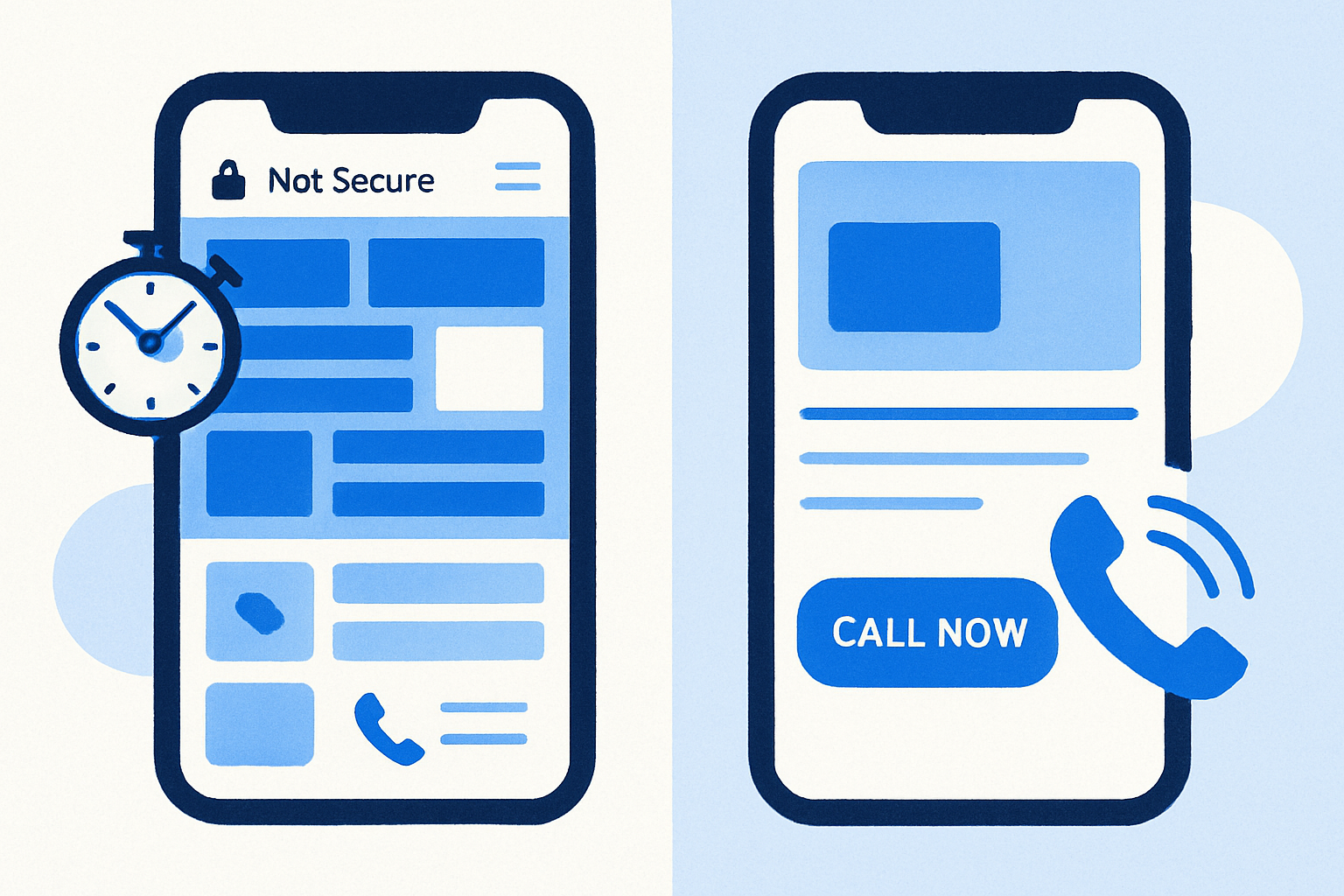
TL;DR
- Anchor every conversation to calls, bookings, or quotes—not 'UX.'
- Pre-find weak-website-intelligence signals, then demo the issue in 30 seconds on mobile.
- Pair each gap with an honest, AI-era fix timeline (20–180 minutes) and a same-day close.
- Package micro-fixes ($150–$500) and quick rebuilds ($500–$1,000) to reduce friction.
- Use tools like Framer AI and Replit for delivery; use WebHunt.ai to find, score, and contact the right leads.
Why "UX" Doesn’t Sell — But Lost Calls Do
Local owners don’t buy "UX". They buy fixes to visible money leaks: missed calls, broken forms, slow pages that make hot prospects quit. If you can point to the exact leak and quote a same-day fix, they’ll listen.
AI changed the pitch. Builds now take hours, not weeks. So the winning conversation is not "big audit, big project" — it’s "cheap, fast fix that restores leads today."
Anchor to one metric the owner already cares about: calls, bookings, or quote requests. Then tie each UX gap to that metric with a 30-second live demo and a credible AI-era timeline using Replit, Framer AI, Base44, v0, Bolt, Lovable, Cursor, Windsurf, Codex Sites, Claude Design, or Claude Code.
Key takeaway: Don’t sell theory. Show the leak, name the minutes to fix, and offer to ship it today.
Find UX Gaps at Scale Before You Call
Pre-qualify niches where UX gaps are common and revenue-linked: plumbers, roofers, HVAC, pest control, dental, and legal. These owners feel a single missed call as real money.
Scan for weak-website-intelligence signals: no HTTPS, non-mobile layout, slow TTFB/LCP, missing tap-to-call, unlinked address, buried CTAs, stale content. Use screenshots (desktop + mobile) to spot hide-and-seek phone numbers, tiny tap targets, and above-the-fold dead zones.
If you’d rather not build the list by hand, WebHunt.ai scores local businesses on website quality signals (HTTPS status, mobile-friendliness, speed, freshness) and review momentum so you can filter for likely buyers fast. Their AI-generated "Deep Analysis" brief includes desktop/mobile screenshots and a suggested pitch angle — a head start for your 30-second demo.
In the AI era, prioritize leads where a same-day rebuild beats patching: single-location service businesses with 3–6 core pages. When the site is slow, unsecured, and form-broken, it’s faster to regenerate a lean version than to bandage legacy cruft.
By the numbers: A same-day 3–6 page rebuild with AI builders is often 120–180 minutes end to end. That’s a new close velocity weapon.
5 UX Gaps Owners Actually Buy (With 30-Second Demos and AI-Era Fix Timelines)
Gap #1: Phone number isn’t tap-to-call on mobile
- Owner translation: “Mobile visitors can’t call you with one tap — every extra step means lost calls.”
- 30-sec demo: On screen-share, open their site on your phone/emulator, tap the number; show it doesn’t launch the dialer. Then show a competitor where it does.
- Revenue tie-in: Local intent on mobile is high; friction on calling kills hot leads. 1
- AI-era fix: Update markup to tel: links, enlarge touch targets, add a persistent sticky "Call Now" button. 20–40 minutes on an existing theme; 1–2 hours folded into a same-day mini-rebuild using Framer AI or Replit.
- Close line: “I can make every number on your site tap-to-call and add a sticky Call Now button before lunch.”
Gap #2: Enquiry/quote form is broken or never reaches inbox
- Owner translation: “People are asking for quotes — you’re not seeing them.”
- 30-sec demo: Live-submit the form with your email/phone on screen-share; show missing confirmation, no CRM/email receipt; check spam; optionally show console/network errors.
- Revenue tie-in: Form failures are invisible lead loss; even 3–5 missed forms/week costs thousands/month in many trades.
- AI-era fix: Replace the form with a reliable service (Formspark/Formspree), verify SMTP/DMARC, add autoresponder and CRM webhook (HubSpot/Pipedrive/Zapier). 30–60 minutes; full site refresh in 2–3 hours.
- Close line: “I’ll fix the form and set up an auto-confirmation so no lead goes dark — today.”
Gap #3: Pages load in 5–8 seconds on mobile
- Owner translation: “People bail before your page shows; slow pages = fewer calls.”
- 30-sec demo: Run Lighthouse/PageSpeed Insights on 4G throttling live; show LCP and a 6–8s waterfall. Compare to a fast competitor.
- Revenue tie-in: More than half of mobile users abandon sites that take over 3 seconds to load. Each extra second of delay can hurt conversions significantly. 2
- AI-era fix: Compress/resize images, lazy-load below-the-fold, remove render-blocking scripts, and move to a modern host/CDN; 60–90 minutes. Or regenerate a lean site in Framer AI/Replit and deploy to a performant edge in ~2 hours.
- Close line: “We’ll cut load time from 6s to under 2s this afternoon and you’ll see the phone ring more.”
Gap #4: No above-the-fold CTA; phone/address buried below the fold
- Owner translation: “Ready-to-buy visitors aren’t told what to do — they leave.”
- 30-sec demo: On mobile, scroll the hero. Count seconds until the first clear action appears; show a heuristic: "eyes land here, but there’s nothing to tap."
- Revenue tie-in: Clear, immediate CTAs increase contact actions on local sites; high-intent traffic needs one obvious next step. 3
- AI-era fix: Add a sticky header with "Call Now" and "Get a Quote," a hero CTA, click-to-call, and a map/directions chip. 45–75 minutes; in a rebuild, ship in 2–3 hours with consistent CTAs across pages.
- Close line: “I’ll make ‘Call’ and ‘Get a Quote’ impossible to miss — today.”
Gap #5: “Not Secure” HTTP warning scares users
- Owner translation: “Your browser literally tells customers your site isn’t safe.”
- 30-sec demo: Open their site in Chrome incognito; point to the "Not Secure" label and show the warning on a form page.
- Revenue tie-in: Chrome flags non-HTTPS pages as "Not Secure" and users are less likely to submit forms when warned. 4
- AI-era fix: Provision TLS and redirect to HTTPS; 15–30 minutes. If on a legacy stack, migrate to a managed host with auto TLS while rebuilding in ~2 hours.
- Close line: “I’ll secure your site and remove the warning in under an hour.”
How to Demo Any UX Issue in 30 Seconds (No Slides)
- Use a phone screen-share + a stopwatch. Show the first 10 seconds of the mobile experience. Ask: “Where would you tap to call?” Then pause.
- Live form test. Submit a test request; confirm whether the owner receives it during the call. If not, silence proves the point.
- Speed proof. Run PageSpeed/Lighthouse in-call; read LCP in seconds out loud; contrast with a fast peer.
- Maps/directions friction. Google “[Business Name] address,” click through their site to driving directions; count taps.
- Microcopy check. Read the primary CTA out loud. If it’s vague (“Learn more”), suggest a direct action (“Call for same-day service”).
- Always conclude with a same-day fix offer and exact timeline: “I can have this live by 4pm.”
Where sourcing leads is the bottleneck, WebHunt.ai can feed you a steady stream of scored local businesses with weak-website-intelligence flags like missing HTTPS, slow speed, and non-mobile layouts. Their AI opportunity briefs make the 30-second demo almost turnkey.
Price and Package the Fix Like It’s 2026, Not 2016
Lead with low-risk, fast outcomes: “Same-day fix, pay on delivery” or “Pilot page goes live first.” Owners are saying yes to micro-packages because AI-era fulfillment is minutes, not weeks.
- Tap-to-call + sticky CTA: $150–$300
- HTTPS + basic speed pass: $150–$400
- Form repair + autoresponder + CRM hook: $200–$500
- Same-day 3–5 page rebuild: $500–$1,000
Guarantees that fit: “If calls or form submissions don’t increase in 30 days, I’ll iterate free.” Avoid hard revenue guarantees until you’ve installed tracking.
For the upsell path, add reputation widgets, review-request automations, and a lightweight content refresh cadence — content freshness is both a ranking and trust signal. 5
Outreach That Converts: From Jargon to Owner Language
Subject lines that point to cash leaks:
- “Your phone number doesn’t tap-to-call on iPhone”
- “3 quote requests last week likely didn’t reach you”
- “Chrome labels your site ‘Not Secure’ — I can fix in 30 minutes”
First line formula: Observation → Impact → Quick win. Example: “Your contact form throws an error on mobile, which means lost quotes. I can fix it today and add confirmations.”
Voicemail script: “I just tried to call from your website but it wouldn’t dial on my phone. I can fix that today — what’s the best number to text?”
SMS opener (where compliant): “Saw ‘Not Secure’ on your site — I can remove it in 30 minutes. Want me to?”
Attach a 20-second screen recording and end with a same-day slot: “I can ship this by 3pm if you want it.” If you need owner contacts without hunting, WebHunt.ai can enrich leads with the owner’s name, direct phone, and email — including confidence scoring and line-type checks — so you start with the right person.
If your bandwidth is capped, you can also launch phone outreach via WebHunt.ai’s human cold-calling marketplace or route first-touch calls to their AI Voice Agent SDR to book qualified meetings directly onto your calendar — helpful when you’re mid-fulfillment and don’t want inbound to stall.
Discovery to Close in One Call
- Clarify the lead metric: “What’s worth more today — extra calls or more quote forms?” Then prioritize the fix accordingly.
- Quantify the hole: “How many calls/quotes do you get daily? If even one a day drops, what’s that worth?”
- Show a live micro-fix prototype: spin a hero with prominent CTAs in Framer AI or Claude Design during the call; share a live link.
- Propose a pay-on-delivery milestone: “If you like the live draft in an hour, I’ll deploy it same day.”
- Collect access the safe way: ask for a temporary editor invite; if blocked, rebuild fast on a modern host and cut over DNS after approval.
To move even faster, pull a ready-to-paste builder prompt: WebHunt.ai can generate a one-click website prompt pre-filled with the business’s real details and photos. Paste it into Replit, Framer AI, or v0 and you’ve got a credible draft in minutes — perfect for a same-call close.
Putting It All Together: A Repeatable Flow
- Source: Build a targeted list in high-LTV trades. Use weak-website-intelligence signals to qualify.
- Outreach: Send a 20-second loom + owner-language subject line; offer a same-day slot.
- Demo: In 30 seconds, prove one costly gap tied to calls/quotes.
- Quote: Offer a micro-package with an exact timeline (20–180 minutes) and pay-on-delivery.
- Fulfill: Use AI builders to ship same-day; confirm tracking and autoresponders.
- Upsell: Propose reviews, CTA consistency across pages, and a light content refresh plan.
This is the AI-native rhythm: pipeline first, proofs in minutes, fixes in hours, cash collected today.
Frequently asked questions
How do I price small UX fixes without undercutting my larger projects?
Anchor pricing to outcome and speed, not hours. Micro-fixes are fast, so keep them under $500 with clear scope and pay-on-delivery. Larger projects bundle multiple wins (design system, sitewide speed, content refresh) and justify $1,000+ even in the AI era by combining outcomes.
What if the owner only wants the micro-fix and not a full rebuild?
Deliver the micro-fix flawlessly and set a 2-week check-in. Bring before/after speed and conversion notes, then propose a quick rebuild to standardize CTAs, performance, and security. The trust from the first fast win often unlocks the broader engagement.
How do I prove impact if call tracking or analytics aren’t set up yet?
Use simple proxies: owner-reported calls, email notifications from forms, and a week-over-week comparison. Install basic call tracking and form autoresponders during the fix so the next iteration has clean data. Keep claims conservative until tracking matures.
What’s the best way to handle legacy CMS access I can’t get quickly?
Don’t stall. Rebuild the critical pages on a modern host using Framer AI or Replit and cut over DNS after approval. You can backfill blog/posts later. Owners care about phones ringing now — ship the fix where you control the stack.
Are there niches where UX fixes won’t move the needle?
Ultra-low-intent or referral-only categories may feel less immediate lift. Prioritize high-intent, service-led trades with phone-first buyers (home services, dental, legal). That’s where a tap-to-call or fast page translates directly into bookings.
How do I ethically use quick wins to build a longer-term engagement?
Be explicit about scope and outcomes, deliver quickly, and document the lift. Use that trust to propose additions that protect revenue: review widgets, speed hardening, and content freshness. Avoid manufacturing urgency; the real urgency is the live money leak you already fixed.
Sources
- 1 Local Search Statistics 2026: Near Me, Mobile & Purchase Data
- 2 Page Speed Statistics 2026: Performance and Revenue Impact
- 3 38 Call to Action Statistics to Boost Conversions in 2026
- 4 HTTPS or bust: Chrome’s plan to label sites as "Not Secure" | Cloudflare Blog
- 5 Content Refresh Prioritization: 2026 SEO Decision Matrix
About the author
Cameron Kirdzik — Founder @WebHunt.ai
Cameron is the founder of WebHunt.ai, where he helps web designers, agencies, and freelancers find local businesses that need a website. He writes practical, field-tested guides on prospecting and closing local clients.