Lead Enrichment Local Business Prospecting: From Name to Warm Conversation
By Cameron Kirdzik — Founder @WebHunt.ai
· 8 min read
TL;DR
- Warm outreach needs more than a name—enrich with owner identity, direct line, web signals, and review momentum.
- Run a waterfall: free signals at volume → AI scoring → paid contact enrichment → pitch assets.
- Use enriched data to pick the pitch angle: no-website, mobile-broken, slow, or stale each get a different opener.
- Throughput wins in the AI era; keep per-qualified-lead research under ~5 minutes by automating steps.
- Track unit economics like an operator: keep enrichment low, monitor connect/meeting rates, and double down on signals that book.
No one buys a redesign from a stranger with a templated email. They book when we sound like someone who already did the homework. That’s the entire point of lead enrichment: turn a raw business name into a warm, specific conversation.
This guide covers lead enrichment for local business pipelines and shows exactly what to collect, how to automate it with AI, and how to map each signal to the right pitch. In the AI era, delivery is hours not weeks (Replit, Lovable, Base44, v0, Bolt, Framer AI, Cursor, Windsurf, Codex Sites, Claude Design/Code). Near‑zero fulfillment cost means prospecting throughput is the ceiling; enrichment decides who deserves paid lookups.
By the numbers: Personalized outreach that references one or two real business facts tends to lift replies meaningfully (commonly 2x+ in our field testing). A single relevant line beats a paragraph of fluff.
Why Enrichment Is the Difference Between Noise and Meetings
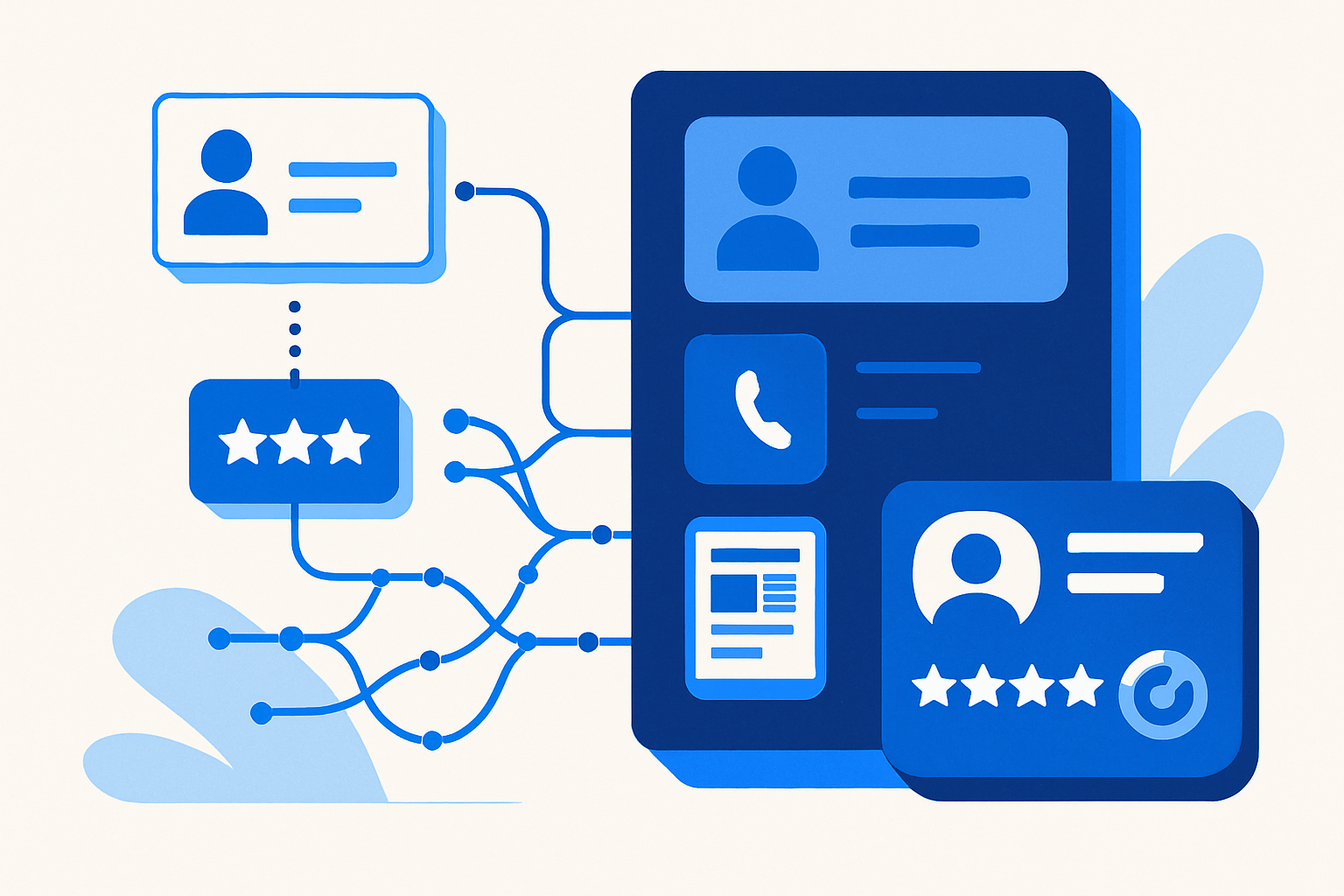
Lead enrichment is simple: augment a raw business name with the owner’s identity, a direct line, website quality signals, review momentum, and category context. That bundle lets you make a specific, credible value statement in your first message—something a generic template never can.
In the AI era, enrichment isn’t just for clever first lines. Because we can deliver in hours, we use the data to choose the fastest-ROI pitch:
- No website → share a live draft today.
- Mobile-broken → 72-hour zero-downtime fix.
- Slow site → before/after speed demo.
- Stale content → monthly update cadence + review replies.
Set a practical goal: 50–100 enriched leads per week per operator, with under 5 minutes average data cost per qualified lead. That’s achievable when AI handles the heavy lifting instead of manual googling.
The Enrichment Waterfall: Free Signals First, Paid Only for Winners
Work in layers so you move fast at the top and only spend on the leads that deserve it.
- Stage 1 — Free signals at volume
- Website presence: missing vs live; HTTPS on/off; obvious mobile issues; speed proxies (heavy page weight, render-blocking); basic readability.
- Google Business Profile (GBP) basics: category, hours, service area.
- Reviews: count, recency, themes; last owner response.
- Category demand proxies: service trades with urgent intent vs boutique retail; high-ticket or emergency-driven categories often close faster.
- Disqualify early: national chains, franchises, obviously saturated competitors.
- Stage 2 — AI scoring
- Auto-score buy likelihood using site weakness + review momentum. Prioritize the top decile for deeper work.
- Stage 3 — Targeted paid enrichment
- Pull owner name + direct phone/email with confidence and phone line type (mobile vs landline). Only spend on the subset already qualified.
- Stage 4 — Pitch prep
- Auto-generate a brief site audit and a ready-to-paste AI builder prompt so your first touch includes a preview or Loom.
- Guardrails
- Cap paid enrichment with a fixed weekly budget and track cost per booked meeting. Adjust thresholds as data comes in.
If you’d rather not build the Stage 1–2 stack from scratch, WebHunt.ai scores tens of thousands of local businesses on website weakness signals, review momentum, and demand, then lets you filter by trade/city—so your Stage 1–2 happens in minutes. Browsing is free; unlock contact details only when a lead qualifies.
Lead Enrichment Local Business: What to Collect
Identity
- Owner’s full name, role, and any review mentions (e.g., “Ask for Maria”). Confirms decision-maker and gives you a non-creepy personalization hook.
Direct lines
- Classify numbers: mobile vs landline. Pick SMS/call vs email sequencing accordingly. Avoid front-desk black holes.
Website quality signals
- HTTPS status; viewport/meta; Lighthouse-style speed bucket; content freshness (last blog/update/date on the site); obvious on-page gaps (no services page, missing CTAs). Grab desktop and mobile screenshots.
Review momentum
- Count, recency, average rating trend, and response behavior. Tie to revenue levers: weak mobile UX leaks bookings; strong demand needs capacity controls.
Category context
- Home services (HVAC, plumbing, roofing, pest) often carry higher LTV and urgent-intent leads; hospitality/personal care can be seasonal and review-driven. Use this to frame ROI and timeline credibly.
Public presence
- GBP categories/hours, top services, photos; quick NAP consistency check for easy wins you can mention.
How to Collect It Fast: AI-Native Methods That Beat Manual Research
AI inference from public pages
- Use LLM entity extraction to pull owner names from About/Reviews/News and auto-validate against state filings or LinkedIn when available.
Automated site scoring
- Run headless checks for HTTPS, viewport tags, and bucket CLS/LCP into simple tiers (good/needs work/poor). Capture a mobile vs desktop diff screenshot. Summarize into a plain-English, two-paragraph brief you can paste into outreach.
Contact enrichment workflow
- Use enrichment APIs that return the owner’s direct phone/email with confidence and line-type classification. Prioritize mobiles for call/SMS.
- WebHunt.ai includes on-demand owner contact enrichment with confidence scoring and mobile‑vs‑landline checks, so you start with the right person and the right channel.
Personalized asset generation
- Produce a one-click AI website-builder draft (Replit, Lovable, Base44, v0, Bolt, Framer AI, Cursor, Windsurf, Codex Sites, Claude Design/Code) pre-filled with the business’s real details. A link to a live draft outperforms a wordy email.
- WebHunt.ai can generate a ready-to-paste builder prompt pre-filled with the business’s info and photos, so you can spin a preview in minutes.
Volume discipline
- Target a 70/30 split: 70% of weekly touches should complete on free/AI steps; only 30% advance to paid lookups. Review hit-rate weekly and raise the bar for paid enrichment if meeting rate drops.
From Data to Pitch: Mapping Signals to Openers That Get Replies
Use the enrichment to choose your opener, not just to personalize it.
No-website lead
- Subject: “Saw you on Google—no site yet? Here’s a live draft.” Body: 2 lines + link to an AI-built preview. Offer a 10-minute review call within 48 hours.
Mobile-broken or slow site
- Subject: “Your site drops leads on phones—30s video.” Include a Loom showing the mobile issue and before/after speed metrics. Propose a 72-hour fix with zero downtime.
- SMS (micro-example): “Hey Maria—quick heads up: your site menu breaks on iPhone. I mocked a 72‑hr mobile fix. 30s clip: [short link]. OK to send a preview?”
Stale content or poor review response
- Subject: “Quick win: fresh specials + auto-review replies.” Suggest a monthly update cadence and templated GBP replies, referencing the last review date.
Great reviews, weak site
- Subject: “You’re 4.8★—your site should match.” Show a mock with trust badges and testimonials pulled from their reviews.
Owner-name personalization that isn’t creepy
- “Customers mention you by name, Maria—built a draft that surfaces that trust on the homepage.” Keep it public-source obvious.
CTA promises enabled by AI delivery
- “Preview in 24 hours, live in 72, pay after demo.” Credible with an AI-first stack.
If you’d like a head start on the brief itself, WebHunt.ai generates AI opportunity briefs per lead (including desktop/mobile screenshots and a plain-English audit) alongside the one-click website prompt. That combo makes it trivial to attach a relevant clip or link in your first email.
Key takeaway: The right opener is a function of the lead’s web signal. Match the pitch to the problem, and reply rates compound.
Scoring, Sequencing, and Timing: Turning Enriched Leads into a Pipeline
Weighted lead score
- Site weakness (40%), review momentum (20%), category demand (20%), contact quality (20%). Work the top-scored leads first; they book faster and cheaper.
Channel sequencing by contact type
- Mobile = call/SMS first, then email.
- Landline = call + voicemail drop + email.
- Owner email = personalized email first, then call.
Cadence that respects local owners
- 5–7 touches over 12 business days. Each touch carries new value: a 30s audit clip, a preview link, or a micro-fix offer.
Timing windows
- Test late afternoon vs just-after-open; many operators see better pickup outside peak service windows. Many also avoid first-touch Mondays due to owner workload—test your market.
Pipeline hygiene
- Stages: New → Enriched → Attempted → Connected → Demo Sent → Meeting Booked → Closed. Require a specific enriched insight (e.g., “no HTTPS; last review 10/2025; owner: Maria”) to move New → Enriched.
To keep this organized without duct tape, WebHunt.ai includes a deal pipeline with save/export, stages, and Zapier/API, so your scoring and contact data flow into a repeatable sequence. If you’re running heavy phones, you can also test WebHunt.ai’s AI Voice Agent SDR or the human cold-calling marketplace to book meetings directly on your calendar when you’re deep in builds.
Compliance, Deliverability, and Data Hygiene
Consent-aware outreach
- Follow TCPA and local telemarketing rules. Favor informational, personalized messages with clear opt-out language in SMS. Regulations vary by state/country; consult qualified counsel for specifics and keep your policies up to date.
Email deliverability
- Warm sending domains; set SPF/DKIM/DMARC; start modestly and ramp thoughtfully; keep one-to-one personalization. Monitor and keep spam complaints as low as possible (sub‑1%); many operators aim for ~0.3%. Test and adjust based on your inbox performance.
Data hygiene loop
- Write bounce and line-type feedback back to your CRM. Auto-suppress bad contacts; update enrichment confidence.
Privacy posture
- Store only what you use. Purge stale PII after a defined inactivity period and honor global opt-outs across channels.
Metrics and Unit Economics in the AI Era
Target guardrails (field benchmarks; test your market)
- Keep enrichment cost per qualified lead lean (often in the ~$1–$2 range for solo operators using a waterfall).
- Target connect rate on mobile numbers in the 15–25% range.
- Aim for meeting-set-per-connect of roughly 20–35% in home services. Ranges vary by niche, timing, and offer.
AI-compressed fulfillment raises your CAC ceiling
- With near-zero build time, you can profitably pay more per meeting than pre-AI models. Model CAC with payback inside the first one to two invoices.
Weekly scorecard
- Volume enriched, paid enrichment spend, meetings booked, previews sent, close rate by pitch angle. Cut the bottom 20% of signals that don’t predict meetings.
Attribution by signal
- Tag each meeting with the trigger insight (no-site, mobile-broken, slow, stale, review gap). Double down where meetings originate.
If you want performance tracking tied to actual lead data, WebHunt.ai lets you save leads, move them across custom stages, and export with the enrichment insights intact. Browsing the scored database is free; use your monthly unlocks for contacts only after your signals say “go.”
Ready to put this to work?
Spin up a weekly enrichment waterfall, match pitch to signal, and promise hours-not-weeks delivery. Find and qualify local businesses that need websites with WebHunt.ai, then turn raw names into warm, specific conversations that book.
Frequently asked questions
What’s the minimum data I need to collect to make local outreach feel warm?
Owner name, a direct line (with mobile vs landline classification), one concrete website weakness, and a review momentum snapshot. That’s enough to personalize credibly and choose a pitch angle like “no-site live draft” or “mobile fix in 72 hours.”
How do I reliably find the owner’s direct phone and avoid gatekeepers?
Use enrichment APIs that return owner name and line-type classified numbers so you can prioritize mobiles for call/SMS. Cross-validate with review mentions (e.g., “Ask for Maria”) and About page names to ensure you’re not calling a receptionist line.
Which website quality signals best predict a local business will buy now?
No website, broken mobile layout, missing HTTPS, and visibly slow pages correlate with urgent pain in our field experience. Pair with review momentum (recent positive reviews indicate demand) to prioritize buyers who feel the impact of a weak site immediately.
What’s a reasonable budget for paid enrichment per week for a solo operator?
Start with a fixed cap—e.g., $50–$100/week—after you filter by free/AI signals. Keep an eye on cost per booked meeting; raise your AI scoring threshold if meetings slip or costs rise.
How should I change my opener if a business has great reviews but a weak site?
Lead with social proof: “You’re 4.8★—your site should match.” Show a quick mock that brings reviews to the homepage and pairs trust badges with a fast, mobile-first layout. It reframes the redesign as a conversion unlock, not a vanity play.
Is SMS outreach compliant for local prospecting and how do I stay within the rules?
SMS can be compliant when you follow TCPA and local telemarketing rules. Keep messages clearly informational and personalized, include an opt-out, send during business-friendly hours, and consult counsel on consent requirements in your jurisdiction.
About the author
Cameron Kirdzik — Founder @WebHunt.ai
Cameron is the founder of WebHunt.ai, where he helps web designers, agencies, and freelancers find local businesses that need a website. He writes practical, field-tested guides on prospecting and closing local clients.