How to Sell Local SEO Services: Packages, Pricing, Proof
By Cameron Kirdzik — Founder @WebHunt.ai
· 9 min read
TL;DR
- Sell outcomes owners can see: Map Pack coverage, review velocity, and tracked calls.
- Package AI-generated content, GBP posts, citations, and FAQ schema as included deliverables.
- Keep margins high: 1–8 hrs/month fulfillment, tools typically ~$150–$300 per client.
- Prove weekly with screenshots, review counts, and call logs; run a 14‑day visible‑win sprint.
- Use a 90‑day keep‑or‑cancel checkpoint tied to the three proxies, not vague revenue promises.
Owners don’t buy “SEO” — they buy map rank, reviews, and ringing phones
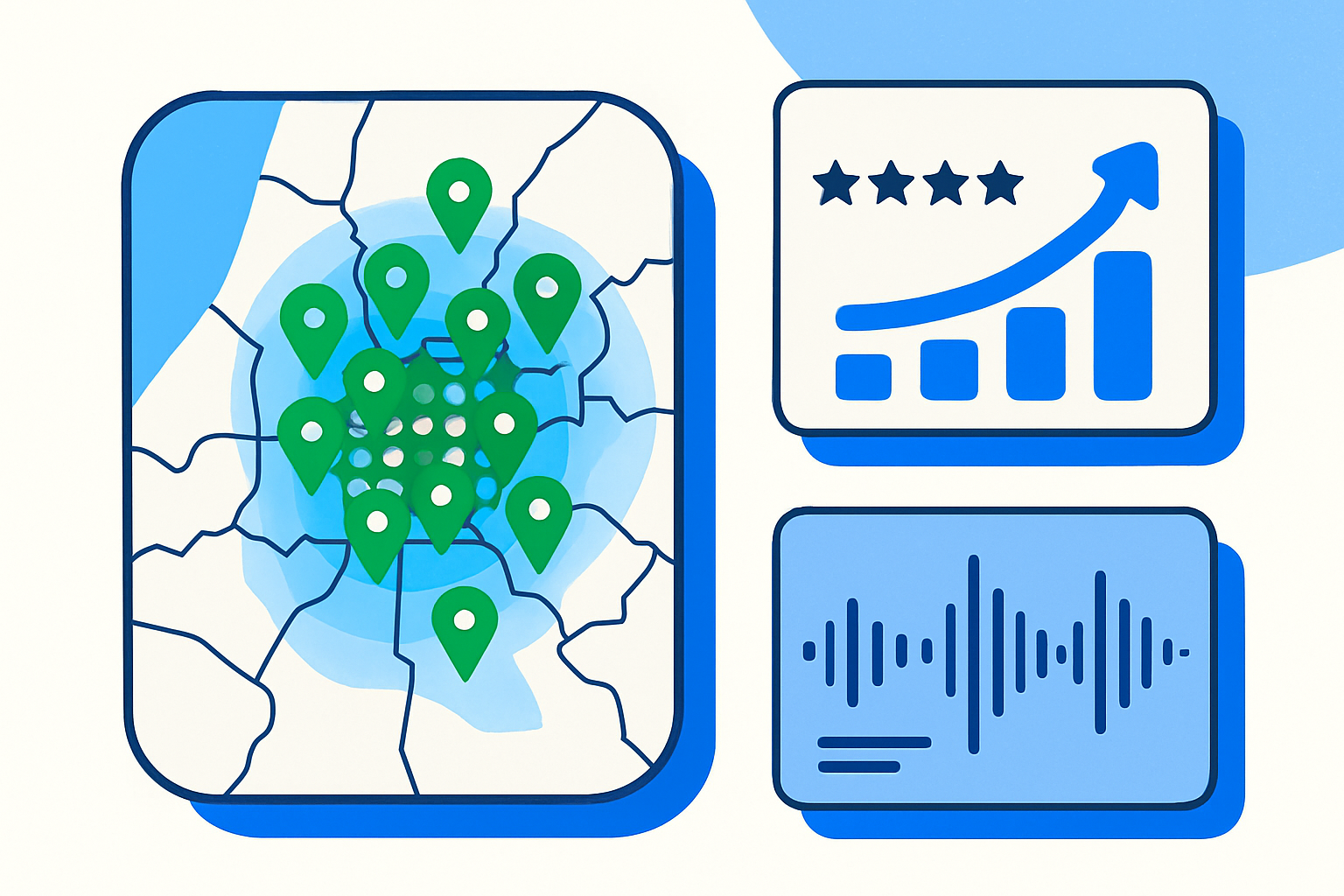
Here’s how to sell local SEO services by packaging around Map Pack coverage, review velocity, and call volume. Local searches drive a disproportionate share of calls in service trades. Reframe your offer around three things owners can verify without you:
- Map Pack position and coverage by ZIP
- Review velocity: new reviews per month and reply rate
- Tracked call volume from GBP and top pages
They can search their term, skim new reviews, and listen to recorded calls in minutes. No dense ranking PDFs.
Set outcome ranges owners understand, with city/competition caveats:
- “Top‑3 coverage for ‘plumber near me’ in 2 target ZIPs.”
- “10–20 net‑new reviews per month.”
- “30–60 net‑new tracked calls per month.”
Key takeaway: You’re not selling hours or backlinks. You’re selling the visible proxies owners equate with revenue.
In the AI era, content and citation work cost near‑zero marginal time. AI can draft service‑page copy, GBP descriptions, posts, FAQs, and schema in minutes. That lets you tie compensation to outcomes without blowing margin.
An AI‑native 3‑package menu owners instantly get
A one‑page menu that converts because it speaks owner language and bakes AI where it belongs—in the engine room, not as a line‑item upcharge.
Package A — Starter: “Show Up” ($397–$597/mo)
- GBP rebuild/optimization (categories, services, photos, description)
- NAP cleanup in top ~25 citations
- 2 service page refreshes (AI‑drafted, human‑edited)
- 1 FAQ schema per refreshed page
- Review system setup (shortlink/cards/QR), review‑reply templates
- Call tracking install (GBP + key pages)
- Monthly proof report (screenshots + call log)
Outcomes (targets, city/competition dependent):
- Initial Map Pack coverage in 1–2 priority ZIPs
- 10–20 review requests sent weekly; first new reviews posted
- First tracked calls from GBP and top service pages
- Screenshot‑able example: grid coverage improves from 1/13 to 5/13 greens for “[service] near me” in two ZIPs by Day 30
Package B — Compete: “Be Chosen” ($897–$1,297/mo)
Everything in Starter, plus:
- 2 geo/service pages per month (AI‑drafted, human‑edited)
- 30–50 citation pushes and cleanup
- 2 GBP posts/week (offers + FAQs)
- 10 review‑request texts/week (owner‑provided list)
- Basic link outreach (local directories/sponsorships)
- GBP spam‑fighting (report name stuffing; suggest edits)
- Quarterly offer testing (headline, CTA, post format)
Outcomes (targets, city/competition dependent):
- Top‑3 coverage across 2–4 ZIPs for 2–3 head terms
- 10–20 new reviews/month
- 30–60 tracked calls/month (split GBP vs. site)
- Screenshot‑able example: 7x7 ZIP grid shows 9/13 greens on “[service] near me” across 3 ZIPs; call log shows 30–60 tracked calls with 2–3 tagged as booked jobs in 30 days
Package C — Dominate: “Multi‑Area” ($1,997–$2,997/mo)
Everything in Compete, plus:
- Location‑page clusters (4–8/mo) and internal links
- Review velocity guarantee (e.g., 20+/mo) with owner‑provided contact list and staff buy‑in
- PR/citation bursts (local media mentions + major data aggregators)
- Service‑area expansion plan (ZIP‑by‑ZIP)
- Lead routing and call‑answer QA (tag/score, coaching snippets)
Outcomes (targets, city/competition dependent):
- Multi‑ZIP dominance for head terms and top services
- 20–40+ new reviews/month
- 60–120+ tracked calls/month
- Screenshot‑able example: coverage expands from 2 to 6 ZIPs with 10+/13 greens on core term; 60–120 calls/month logged with 5–10 tagged as booked jobs
AI‑era deliverables (included, not add‑ons)
- AI‑generated drafts for service pages, GBP descriptions/posts, citation blurbs, and FAQ schema using modern assistants (e.g., Claude, Cursor, v0, Bolt) — human‑edited before publishing.
- Because AI handles drafts, your differentiator is speed‑to‑proof: same‑week pages/posts and weekly proof emails.
Owner responsibilities per tier: grant GBP and CMS access on Day 1; provide a monthly customer contact list for review requests; approve content within 48 hours to maintain velocity.
Menu layout tip: three columns—Deliverables, Outcomes (Map Pack coverage, review velocity, calls), and 90‑day milestones. Make it skimmable and numbers‑first.
If you want a qualified lead list to hand this menu to, WebHunt.ai can surface local businesses scored by website weakness, review momentum, and demand signals, so you pitch owners most likely to buy.
Pricing and unit economics in the AI era
With AI drafting and templatized workflows, monthly fulfillment typically compresses to:
- Starter: 1–3 hours
- Compete: 3–5 hours
- Dominate: 6–8 hours
At the listed ASPs, that sustains healthy gross margins for most operators.
Stack costs to expect per client (at scale): call tracking number(s), GBP posting workflow, review‑SMS, citation manager, AI assistants, and lightweight link/reputation tools. In our experience, all‑in software/telephony typically lands ~$150–$300/month per client depending on volume.
Price floor rule: never price below your 3‑month CAC + tools. Example: $350 CAC and $200/mo tools. Starter at $497/mo breaks even in month 2, then high‑margin.
Commitment terms: 90‑day initial term, then month‑to‑month with a keep‑or‑cancel checkpoint if the three proxies (grid coverage, review count, tracked calls) don’t improve against agreed targets. This is credible now because switching cost is near‑zero—AI fulfillment makes it easy to win fast or release cleanly.
Positioning contrast: legacy agencies still bill for manual copy, citations, and schema as high‑labor tasks. You include those as table stakes and price on outcomes—not hours.
By the numbers: If fulfillment time is 3 hours and your effective billable is $1,297, you’re earning >$400/hour on delivery while spending your real time on prospecting and proof.
Your proof plan: what to measure, how often, and what screenshots to send
KPI set owners actually look at:
- Map Pack coverage for 3–5 head terms across target ZIPs; include a 7x7 ZIP grid screenshot that shows before/after coverage
- Monthly new Google reviews and average rating
- Tracked calls by source (GBP vs. site), qualified vs. spam
- Top‑page and GBP view trends
Cadence that converts:
- Weekly: quick proof email—3 screenshots + one‑line deltas
- Monthly: concise PDF or dashboard link with before/after visuals and a 90‑day trendline
- Quarterly: review call with recorded‑call highlights and next‑step plan
Evidence artifacts to include:
- GBP Insights screenshots
- Call log with tagged outcomes and 3 recording links
- Grid‑based local rank visualization (before/after)
- Review feed with timestamps and your reply rate
- Citation index growth snapshot
Attribution specifics: unique call tracking numbers on GBP and on key pages, UTM tags on the GBP website button and posts, and form tracking. Confirm call‑recording consent requirements locally and configure announcements/storage accordingly. You’ll often see movement on competitive terms within weeks if approvals are fast.
AI assist for reporting: paste raw metrics into an AI assistant to auto‑draft a concise, owner‑readable narrative. Keep it one screen.
If you need lightweight workflow for tracking leads through proof stages, WebHunt.ai includes a deal pipeline you can use to save leads, move them across stages, and export proof packs.
A 14‑day ‘visible win’ sprint to convert skeptics
Day 1–2: GBP overhaul—primary/secondary categories, services, photos, description; add call tracking; publish 2 GBP posts (offer + FAQs).
Day 3–5: NAP cleanup and top ~25 citations; generate citation blurbs with AI; submit to major data aggregators where relevant.
Day 6–7: Review engine live—SMS/email templates, QR cards, front‑desk script. Send 10–20 requests. Reply to the last 10 reviews with AI‑drafted but human‑edited responses.
Day 8–10: Publish 2 service pages (AI‑drafted copy + FAQ schema) with location modifiers; interlink from homepage and GBP.
Day 11–14: Competitor spam‑fighting (report name stuffing), 2–3 local sponsorship/chamber links, 2 more GBP posts. Confirm call recordings and tag 5 sample wins.
Deliver a Day‑15 proof email: 7x7 grid before/after, new review count, call log with recordings, and the next 30‑day plan. Offer a “cancel now if not impressed” clause to de‑risk.
Sales script and objection handling (owner‑visible promises you can keep)
Open:
- “We get you into the top 3 in your service area, grow your reviews every week, and make your phone ring—you’ll see it in screenshots and call recordings.”
Demo‑first:
- Show a competitor vs. prospect grid heatmap and two anonymized call clips before tactics. Make the outcome tangible.
Guarantees you can keep:
- Review velocity guarantee (e.g., 20+/mo) with owner‑provided contact list and staff buy‑in
- Weekly proof‑email SLA
- 90‑day improvement checkpoint on defined grid coverage, review count, and tracked calls—not absolute #1 promises
Objection: “We tried SEO; nothing happened.”
- Walk through your 14‑day sprint and show a Day‑15 proof pack. Emphasize near‑zero switching cost and try‑before‑commit builds.
Objection: “We don’t have time for content.”
- You draft pages, GBP posts, and review replies with AI; they approve in 48 hours. Show a one‑page approval workflow.
AI‑era angle: you can promise “first visible wins in 14 days” because AI handles content/citations/schema while you spend human time on outreach, proof, and local authority plays.
If you want help booking meetings while you build proofs, the WebHunt.ai AI Voice Agent SDR can call leads, pitch your value props, and drop meetings onto your calendar within your compliance guardrails.
Prospecting: who to target and how to qualify fast
Best‑fit niches: high‑LTV, phone‑driven trades with weak web presence and low review velocity—plumbers, roofers, HVAC, pest control, legal, medical specialties—where a single booking can cover a month of service.
60‑second qualification signals:
- GBP category gaps or wrong primaries
- Fewer than 50 reviews or <4.2 average
- No recent GBP posts
- Inconsistent NAP across top directories
- Slow mobile site, non‑HTTPS, sparse service pages
City filter: mid‑tier suburbs (50k–250k population) where Map Pack competition is winnable in 90 days. Avoid saturated cores until budgets match.
First‑touch asset: a one‑page audit with three screenshots (7x7 Map Pack grid, review velocity trend, GBP errors) and your 14‑day sprint. Send it before the call to pre‑qualify.
To fill the top of funnel fast, use WebHunt.ai to filter by trade + city and sort by weakness signals (HTTPS, mobile, speed, content freshness) and review momentum. Open its AI opportunity briefs to see screenshots of the current site and a suggested pitch angle—handy for assembling your 1‑page audit in minutes. Use WebHunt.ai owner contact enrichment to pull the owner’s direct phone/email with confidence scoring so your first proof email and follow‑up call reach the decision‑maker.
Case study and ROI math owners respect
Template: one page with before/after Map Pack grids, review count change, and call volume delta. Add three call recording snippets with dollar‑value annotations.
ROI example: if the average job is $600 and close rate on tracked calls is 35%, then 40 net‑new calls/month ≈ 14 jobs ≈ $8,400 revenue. At a $1,297/mo retainer, ROI ≈ 6.5x. Include a small sensitivity table (+/− 10 calls, +/− 10% close).
Vertical conversion ranges: many service trades convert a meaningful share of qualified inbound calls to booked jobs. Publish your observed range and update quarterly.
Proof‑of‑work standard: maintain a time‑stamped changelog (GBP edits, posts, citations submitted, pages published), note which parts were AI‑drafted vs. human‑edited, and record owner approvals. Radical transparency beats legacy opacity.
Turn case studies into outreach: a 3‑screenshot email, a 60‑second Loom, and a one‑click calendar link. PS: “Hear 2 call clips like these.”
If you need quick demos for prospects with weak sites, WebHunt.ai can generate a one‑click website‑builder prompt pre‑filled with real business details so you can show a live draft alongside your SEO plan.
Implementation checklist (quick reference)
- Define the three proxies and 90‑day targets per client
- Install call tracking + UTM tagging; confirm call‑recording consent requirements locally
- Launch review engine; set weekly send and reply cadence
- Publish 2–4 location/service pages/month with FAQ schema
- Push citations and fix NAP; schedule GBP posts weekly
- Send weekly proof email; monthly dashboard; quarterly review with call clips
For a simple pipeline to track outreach → sprint → proof → close, save prospects inside WebHunt.ai and move them through deal stages as your evidence builds.
Ready to put this to work?
Prospecting is the ceiling now—not fulfillment. Find scored local businesses with weak web presence and real buy‑signals, then run your 14‑day proof sprint. Get started with WebHunt.ai to identify, qualify, and pitch owners who will actually pay for visible local outcomes.
Frequently asked questions
How long does local SEO take to show results in the Map Pack?
You can usually show first movement in a few weeks with a focused sprint (GBP overhaul, citations, review velocity, and 2 service pages). Competitive head terms may take longer, but grid coverage across target ZIPs often starts warming within the first month if approvals are fast.
Can you guarantee #1 rankings for my main keyword?
No one can credibly guarantee #1. Instead, we commit to improvement targets across a defined ZIP grid, plus review growth and tracked calls. We back that with weekly proof—screenshots, review counts, and call logs—and a 90‑day keep‑or‑cancel checkpoint tied to those proxies.
What do we need to provide for review requests and content approvals?
Grant GBP and website CMS access on Day 1 and share a monthly customer contact list for review requests. We deliver AI‑drafted pages and posts; you approve within 48 hours so we can maintain review velocity and posting cadence.
How do you use AI in local SEO, and is it safe?
AI drafts service‑page copy, GBP posts, citation blurbs, and FAQ schema. We human‑edit for accuracy and brand fit before publishing. AI isn’t a ranking trick—it’s a production accelerator that lets us deliver same‑week assets and weekly proof without bloated retainers.
What if call volume doesn’t increase after 90 days?
We review attribution data (UTMs, call logs, form fills), adjust ZIP targets or offers, and if the three proxies haven’t improved against agreed benchmarks, you can cancel. Our near‑zero switching cost means we put performance first.
Do I have to sign a long‑term contract for local SEO?
We start with a 90‑day term to earn the right to continue, then go month‑to‑month. You’ll receive weekly proof emails and monthly dashboards, so continuing is based on visible progress—not a long contract.
About the author
Cameron Kirdzik — Founder @WebHunt.ai
Cameron is the founder of WebHunt.ai, where he helps web designers, agencies, and freelancers find local businesses that need a website. He writes practical, field-tested guides on prospecting and closing local clients.