How to Get Handyman Services Web Design Clients
By Cameron Kirdzik — Founder @WebHunt.ai
· 8 min read
TL;DR
- Hunt older-home suburbs and active Google Business Profiles with weak or missing sites; one extra $150–$600 job can ROI a starter build fast.
- Lead with a mobile-first, 3-page site + tap-to-call, tap-to-text, and today/tomorrow booking—delivered same day in most cases.
- Use seasonal micro-service pages (gutter clean, deck/fence fixes, holiday punch-list) as your opener and ongoing follow-up cadence.
- Price $300–$800 for the build and $100–$300/mo for updates, GBP care, and missed-call text-back; anchor to extra jobs, not pixels.
- Run a tight pipeline: 40–60 adds/week, 3 touches in 72 hours with a live draft, weekly seasonal follow-ups for a month.
Handyman Services Web Design Clients: A Prospecting Playbook
Handymen buy outcomes, not aesthetics. In most markets, common handyman tickets land around $150–$600; one extra booking can ROI a basic site within days. That gives you a clean angle: own the direct calls (no marketplace fees) and smooth demand during seasonal spikes with same/next-day booking.
Most handymen stitch work from Google Business Profile (GBP), Facebook groups, Nextdoor, and Angi/Thumbtack. The gap is repeatable: no standalone site or a thin, slow, or non-mobile page that leaks calls. AI builders compress delivery to hours, so you can show a live, mobile-first draft before your competitors finish their intro email.
Key takeaway: Sell “2–5 more booked jobs a week without marketplace fees,” not “a prettier theme.”
Why handymen are a high-ROI niche in the AI era
- Jobs are short and frequent. A call button and today/tomorrow slots move the needle immediately.
- Seasonality = built-in door-openers: deck/fence fixes in spring, pre-fall maintenance in late summer, and pre-holiday interior punch-lists.
- Most owners are on the tools. They want phone-first flows (tap-to-call, tap-to-text) and minimal admin.
- With Replit, Lovable, Base44, v0, Bolt, Framer AI, Cursor, Windsurf, Codex Sites, Claude Design, or Claude Code, you can usually text a live mockup within the hour.
Where to find handymen with weak or missing websites
Work the channels where solo operators live and digital gaps surface:
- Google Maps: search "handyman + [city]". Prioritize GBPs with no website, a Facebook link, or a free subdomain (e.g., wixsite/google sites) and mismatched NAP.
- Marketplaces (Angi/Thumbtack/Taskrabbit): scan top-rated pros listing only a phone and Gmail. They’re primed for a "book direct—skip fees" pitch.
- Facebook groups + Nextdoor: posts with phone pics, Cash App handles, and availability windows. Log names, towns, and service clues from comments.
- Yard signs/truck wraps: phone-only branding is a strong "no-site" tell. Snap and add to your list.
- City contractor/permit boards: pull "handyman" or "home repair" and cross-check for standalone domains.
- Geo priority: target suburbs with high owner-occupancy and older housing stock—these areas produce more small-fix demand.
If you’d rather start with a scored list, WebHunt.ai lets you filter by trade, city/state, and website weakness signals (missing site, HTTPS, mobile, speed, freshness) and ranks leads by likely buy-readiness, including review momentum.
Pro tip: When profiles lack owner names or direct lines, use WebHunt.ai owner contact enrichment to pull the decision-maker’s name, direct phone, and email—plus mobile vs. landline checks—so you start with the right person.
Qualification: signals a handyman will buy now
Use a two-stack filter: website weakness + active demand.
- Website weakness: no site or only Facebook; non-HTTPS; slow or non-mobile; no services list; missing tap-to-call; no booking; "last updated" looks stale.
- Demand momentum: 4.5+ rating, 20–200 reviews, and a fresh review in the past 30–60 days—evidence of steady inflow you can improve.
- Job mix: posts or ads for 30–60 minute tasks (TV mounting, faucet swaps, door repair, drywall patch) that benefit from quick booking.
- Responsiveness: they answer mid-day calls/SMS; voicemail mentions service areas or windows. Signals they care about inbound.
- Capacity flags: "Booked out 3–5 days" and no online booking—your fast-path to value.
To accelerate this triage, run WebHunt.ai’s AI opportunity briefs on saved leads. Each “Deep Analysis” includes desktop/mobile screenshots, what’s broken or missing, and a tailored pitch angle you can paste into your outreach.
By the numbers: Converting just 1–2 extra jobs per month often covers the monthly plan at typical $150–$600 job values.
Outreach that resonates with handymen (scripts + assets)
Handymen are phone-first and time-poor. Lead with immediate outcomes, then show proof.
- Core promise: "Add tap-to-call and today/tomorrow slots—capture 2–5 more jobs/week without marketplace fees."
- Seasonal hook: "Deck screws and gate sags spike every April—here’s a page + booking just for that."
- Cold call opener: "Hey [Name], saw your GBP—looks like calls hit voicemail when you’re on jobs. I spun up a 3-page mobile draft with tap-to-call + ‘Today/Tomorrow’ booking. Want me to text the link?"
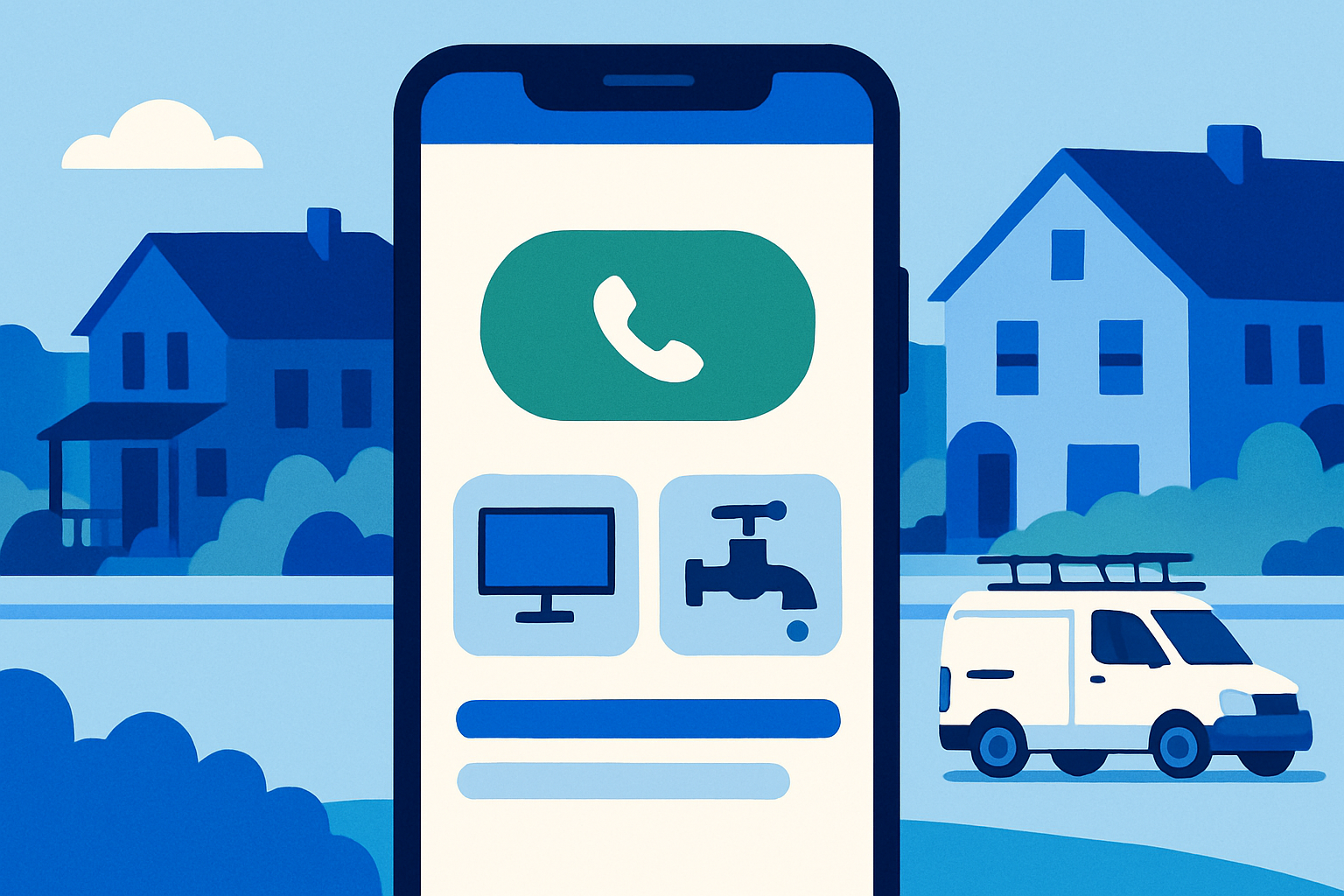
- SMS follow-up: share a 10–20s Loom of the mobile draft with a big thumb-friendly call button and service tiles. CTA: "Reply 1 to swap in your number and hours—takes 10 minutes."
- Email subject: "Your April deck-fix page (mockup)" or "Stop paying Angi for calls you can own." Put a screenshot above the fold.
- Risk reversal: "I’ll launch on a temp domain today; pay only if you approve. We’ll point your domain the moment you say yes."
Speed matters. Use the one-click website prompt inside WebHunt.ai to generate a ready-to-paste prompt for your preferred AI builder (Replit, Lovable, Base44, v0, Bolt, Framer AI, Cursor, Windsurf, Codex Sites, Claude Design, Claude Code) pre-filled with the business’s real details and photos—so the draft looks like them, not a template.
Your offer and pricing: make the first job a no-brainer
AI-era pricing anchors to outcomes, not hours.
- Starter package (AI-built, same day in most cases): $300–$800 one-time for a 3-page site (Home, Services, Book/Call) + GBP sync + SMS tap-to-call. Include 30 days of minor edits.
- Performance plan: $100–$300/month for managed GBP updates, seasonal service pages (e.g., "Gutter Cleaning October Special"), and missed-call text-back.
- Risk reversal: "Try-before-you-commit" on a temp domain. If approved, they pay and you point the domain immediately.
- Upsell modules (hours, not weeks):
- Review widget + SMS review ask
- Add FAQ schema to improve rich-result eligibility
- Mini service-area pages for top 3 neighborhoods
At $300–$800 build and $100–$300/mo, margins stay healthy because AI builders compress fulfillment to hours. Converting just 1–2 extra jobs per month typically pays for the monthly plan many times over at typical job values.
Handling objections specific to handymen
- "I get enough work from Facebook/Angi." Reply: "Siphon 3 marketplace leads/month into direct calls and you keep the fee and the repeat customer—no middleman."
- "I don’t have time for this." Reply: "10-minute setup call. I’ll pull services from GBP, grab photos, and launch today. You only confirm phone and hours."
- "People just want to text." Reply: "Perfect—your site will feature tap-to-text and missed-call text-back. Preload reply: ‘TV mounting runs $120–$180 depending on wall. Free today 3–5pm or tomorrow 9–12. Text which works.’"
- "I move between towns." Reply: "We’ll add a service-area toggle, a map, and a ‘Where I’ll be this week’ note you can text me—I’ll update the site in 60 seconds."
- "I already have a site." Reply: "If it’s missing HTTPS, a mobile call button, booking, or it’s slow—I’ll refresh it for $0. Pay only if you approve the 24-hour upgrade."
Execution stack and timeline (built for same-day delivery)
This is designed as a same-day product in most cases.
- Hour 0–1 (demo): Generate a 3-page draft in Framer AI or Replit. Services grid: TV Mounting, Faucet Install, Door Repair, Ceiling Fan, Drywall Patch. Add tap-to-call and tap-to-text.
- Hour 1–3 (conversion): Embed Calendly/SavvyCal with two today/tomorrow slots. Configure missed-call text-back. Add GBP NAP and service-area schema.
- Hour 3 (proof): Send a 30–60s Loom of the mobile view. Ask for domain + card only after approval.
- Same day–Day 1 (go live): Connect domain, submit to Search Console, update GBP website link and services.
- 90-minute build checklist: text-based logo, hero tied to quick wins, 5-star review strip, top-5 FAQs (price/availability), tap-to-text, and 3–5 before/after photos.
Keep production lean with AI. Use Cursor or Windsurf to code small components, Claude Design for sections, and Codex Sites for one-command scaffolds. The goal: get a credible mobile mockup in their hands fast.
Pipeline math and follow-up cadence (handyman-shaped)
You’re running a numbers game that spikes once prospects see a draft.
- Volume: Add 40–60 qualified handymen weekly. Expect 8–12 live conversations and 2–5 approvals if you lead with drafts.
- Touch cadence: 3 touches in 72 hours (call → SMS with mockup → email with screenshot), then 1 weekly seasonal angle for 4 weeks (e.g., "Storm door tune-ups this month").
- KPIs: answer rate by time-of-day; SMS reply rate to mockups; approvals per 10 drafts; go-live time from first contact; retained monthly add-ons.
- Resurrection play: Before each seasonal peak, text a new micro-service mockup (e.g., "Gutter Clears October") to prior no’s—expect a slice to reopen.
- Mobile reality: Most local home-service searches are mobile—design for thumbs first.
If you’re scaling dials, WebHunt.ai offers an AI Voice Agent SDR that calls leads, pitches your offer, and books meetings on your calendar with compliance guardrails. For tracking and automation, use WebHunt.ai’s deal pipeline and workflow; its public API/Zapier and exports make it easy to sync drafts, Looms, and scheduling across your stack.
Trade-specific scripts you can deploy today
- 30-second voicemail: "Hey [Name], it’s [You]. I mocked up a 3-page mobile site for [Business]. Big green ‘Tap to Call’ and a ‘Today/Tomorrow’ booking button. No cost unless you like it. I’ll text the link now—reply ‘1’ if you want me to point your domain today."
- First SMS: "Draft for [Business]: [link]. Tap-to-call demo works; services: TV Mounting, Faucet Install, Door Repair, Ceiling Fan, Drywall Patch. ‘Today/Tomorrow’ booking is live. Want me to swap in your number + hours? Takes 10 mins."
- Seasonal follow-up (April): "Deck screws and gate sags spike this month. I mocked a ‘Deck/Fence Fix—Same Week’ page: [link]. Want it live under your domain by 3pm?"
- Marketplace migration: "You’re paying per lead on Angi. I’ll add a ‘Book Direct—Save the Fee’ strip and a coupon on your site. We’ll measure calls moved off the marketplace this week."
Micro-service pages that print calls
Build pages for quick, profitable jobs. Keep them scannable and mobile-first.
- TV Mounting (same/next day)
- Faucet/Disposal Swap
- Door Repair and Re-hang
- Ceiling Fan/Light Install
- Drywall Patch (under 2 ft²)
- Gutter Clean & Tune (seasonal)
Pattern: price range + time estimate + 3 FAQs + before/after photo + tap-to-call and tap-to-text. These rank fast on brand queries and convert well from GBP clicks.
One-week ramp plan
- Day 1–2: Pull 100 handymen across 3 older-home suburbs. Use WebHunt.ai filters (trade, city, weakness) to start at the top of the score stack. Enrich 30–40 owners for direct phones.
- Day 3–4: Generate 10 drafts via the one-click prompt in WebHunt.ai and your AI builder of choice. Text live mockups using the scripts above.
- Day 5: Close 2–5. Go live within 24–48 hours. Update GBP links and enable missed-call text-back.
- Day 6–7: Launch one seasonal page per client. Queue resurrection texts to no’s with a fresh micro-service angle.
Frequently asked questions
What services should a handyman website highlight to convert more calls?
Lead with fast, profitable micro-jobs: TV mounting, faucet/disposal swaps, door repair, drywall patch, ceiling fan installs, and seasonal items like gutter cleaning. Add price ranges and time estimates plus tap-to-call and tap-to-text so homeowners can book in under 30 seconds.
How much should I charge a handyman for a simple website now?
A strong starter offer is $300–$800 for a same-day 3-page site (Home/Services/Book) and $100–$300/month for GBP updates, seasonal pages, and missed-call text-back. Margins stay healthy because AI builders compress fulfillment to hours.
Do handymen really need online booking, or is click-to-call enough?
Click-to-call is essential, but adding today/tomorrow booking captures after-hours traffic and buyers who don’t want to talk. Pair it with missed-call text-back to win calls when the owner is on a ladder or in transit.
How do I migrate a handyman off Angi/Thumbtack without hurting leads?
Don’t rip the Band-Aid. Keep marketplace profiles but add a “Book Direct—Save the Fee” strip on the site and GBP. Build micro-service pages for their top earners, track the share of direct calls, and taper marketplace spend over 2–4 weeks.
What content do I need from a handyman to launch in 24 hours?
Two before/after sets, a headshot or text logo, the top 5 services with price ranges, service areas, hours, and the best phone for calls/texts. Everything else—copy, FAQs, and booking—can be templated and refined after go-live.
How do I rank a handyman site locally without a big SEO budget?
Win brand + service searches first: link GBP to the site, add service-area schema, and publish micro-service pages tuned to real jobs. Use SMS review asks to build review velocity, embed a review strip, and add 2–3 neighborhood pages over time.
About the author
Cameron Kirdzik — Founder @WebHunt.ai
Cameron is the founder of WebHunt.ai, where he helps web designers, agencies, and freelancers find local businesses that need a website. He writes practical, field-tested guides on prospecting and closing local clients.