How to Find Businesses with Non‑Mobile Websites (and Close Them Fast)
By Cameron Kirdzik — Founder @WebHunt.ai
· 8 min read
TL;DR
- Mobile-broken sites (pre-2015 builds) outnumber no-website businesses in many trades and are easier to prove and close.
- Do a 90-second mobile check: horizontal scroll, tiny text, cramped taps, no click-to-call, clipped content.
- Prioritize high-LTV trades and leads with recent reviews or paid ads going to broken mobile pages.
- Lead with a live phone demo and an AI-built draft: “mobile-first automatically; draft by end of week.”
- Fulfill in days with AI builders; track pipeline math and scale with calling/automation.
Why mobile-broken beats no-website leads in 2026
Millions of local business sites were built before 2015 — before responsive was the default — and many still break on mobile. In a lot of service trades, that pool is larger than the true no-website cohort.1 Owners feel this every time they try to read their own homepage on their phone.
Mobile now accounts for the majority of local discovery and search touchpoints. When the site isn’t mobile-ready, calls, form fills, and direction taps drop — you can see it (and show it) in a single scroll.2
In the AI era, the fix is cheap and fast. Tools like Replit, Lovable, and v0 produce mobile-first layouts by default. That crushes fulfillment cost by roughly 90–95% and pulls timelines from weeks to hours. In high-LTV niches (HVAC, roofing, pest, legal, medspa), the ROI is often a single extra booking.
Compared head-to-head, no-website leads require more education and intent verification. Mobile-broken leads have a visible, undeniable defect and an easy before/after demo. Prioritize the latter for faster closes.
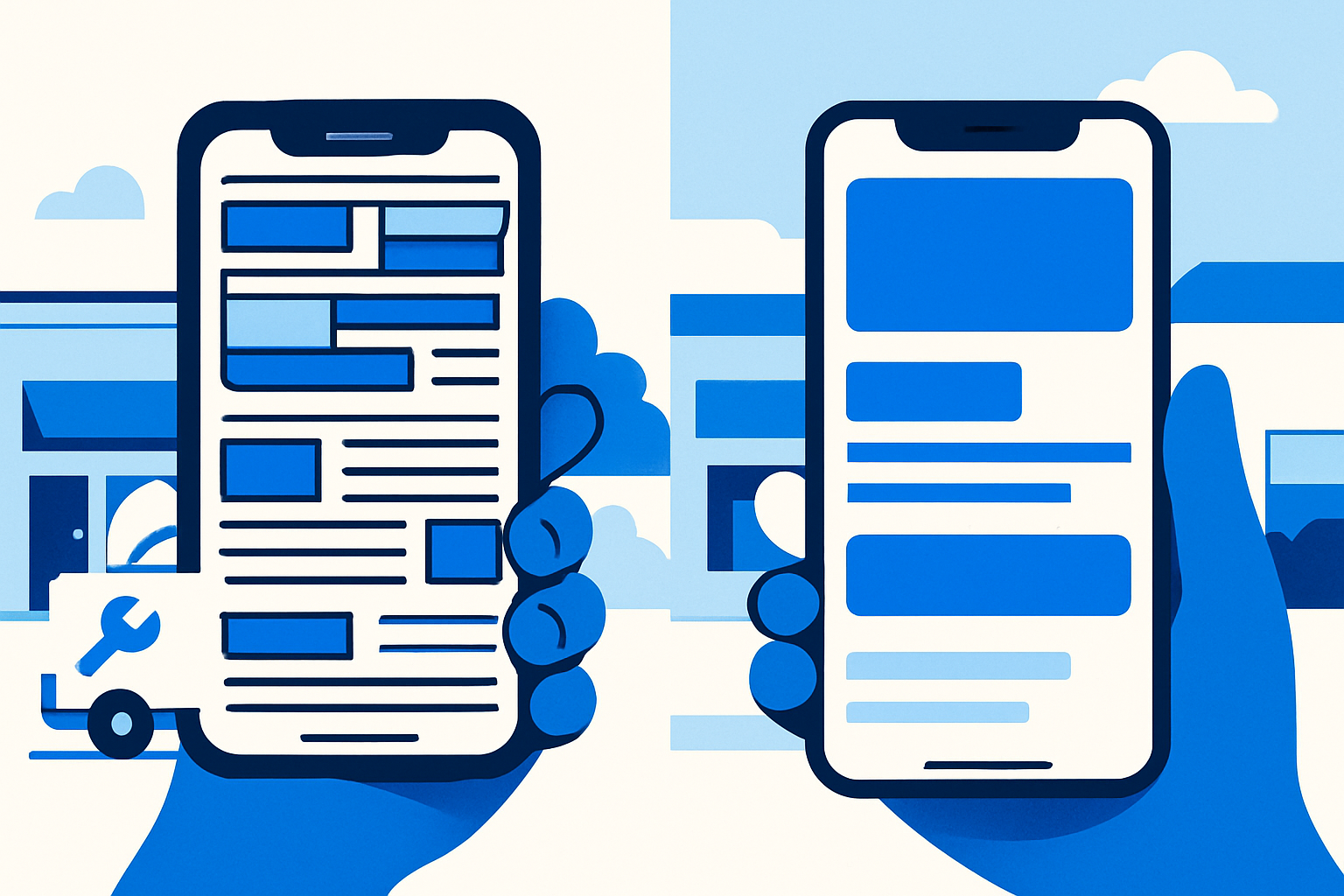
Key takeaway: You don’t have to convince them websites matter — you just have to show their website doesn’t work on a phone.
Fast mobile-broken check vs full responsive audit (what to look for)
You don’t need a lab. Do this 90-second check on any phone:
- Horizontal scroll appears on the homepage.
- Text effectively <16px — if you need pinch-to-zoom, it fails.
- Tap targets <44px — menu items are cramped or stacked too tight.
- Phone number isn’t click-to-call.
- Above-the-fold content is clipped or overlapping.
If you hit two or more, it’s mobile-broken.
Technical spot-checks:
- Meta viewport tag: View source; if
<meta name="viewport">is missing, or it’s fixed width (e.g.,width=980), that’s a red flag. - Legacy tells: fixed-width tables, Flash-era sliders, image text baked into banners, hover-only dropdowns.
- Chrome DevTools: Toggle the Device Toolbar, run a Lighthouse Mobile audit, and screenshot “Tap targets too small,” “Content wider than screen,” and “Text too small to read.” Those three alone are instant proof assets.
When a full responsive audit is warranted (bigger clients or bundled SEO), check:
- Breakpoints coverage: <=360px, 390–430px, and ~768px.
- Hero and gallery scaling, form and calendar widgets, embedded map iframes.
- Sticky headers overlapping content, layout shift on slow 4G, and mobile performance basics (TTFB/INP/LCP).3
Qualification rubric (0–20):
- Readability (0–5)
- Navigation/Tap Targets (0–5)
- Speed on Mobile (0–5)
- Conversion Basics: click-to-call, sticky CTA, directions (0–5)
Anything ≤11/20 is a high-priority mobile-broken lead.
How to find businesses with non-mobile websites at scale
Start where the opportunity pools are deepest:
- Trades that predate 2015 refresh cycles and live on phone leads: plumbers, roofers, electricians, pest control, towing, medspa, dental, injury law.
- Geo: mid-income suburbs and older business districts; lots of SMBs haven’t redesigned in a decade. Pair with high-LTV services for bigger, faster ROI.
Use weak-website-intelligence signals:
- Missing HTTPS, slow speed, stale content, and poor mobile-readiness co-occur with mobile-broken layouts. Build a target list around those.
If you’d rather not build that list by hand, WebHunt.ai scores tens of thousands of local businesses on mobile-readiness, speed, HTTPS, and content freshness, and lets you filter by trade and city. It’s a fast way to surface the “mobile-broken likely” segment inside a metro.
Batch-validate at volume:
- Open 20 candidate sites, run Lighthouse Mobile, and save screenshots of failed audits into your sheet. Those images become your outreach proof.
- Outbound goal: 50–100 new checked domains per week; in legacy-heavy niches, expect 20–40% to show 2+ mobile fails.
Add context for pitch personalization:
- Automate capture of NAP, category, last update, and 1–2 specific mobile issues.
- If you’re using WebHunt.ai, its AI opportunity briefs (“Deep Analysis”) include mobile/desktop screenshots and a suggested pitch angle you can paste into your outreach, which saves minutes per lead.
Prioritization and qualification: who’s ready to buy a mobile fix now
- Review momentum: Businesses with reviews in the last 60 days are active and investing — they convert faster.4
- Lead value: Favor trades with $300+ average tickets or high LTV — an incremental job covers your fee.
- Ad signals: If they’re paying for Google Ads but sending traffic to a broken mobile page, urgency is highest; money is being wasted right now.5
- Ownership access: Direct owner or partner contact wins. Gatekeepers slow simple fixes despite the obvious ROI.
- Competitor gap: If the top three competitors have clean mobile sites, your target is bleeding calls. Pair a SERP snippet with your broken-mobile screenshot to frame the loss.
A quick score you can use today:
- Buy Likelihood = (Mobile-Broken Severity ×2) + Review Momentum + Category LTV + (Active Ads ×2) + Direct Owner Contact
If you want owner details without hunting, WebHunt.ai can enrich a lead with the owner’s name, direct phone, and email, plus phone line-type checks so you’re not calling a dead landline. That small edge lifts contact rate on these fast-cycle pitches.
By the numbers: Recent reviews + active ads + severe mobile fails is your “today” bucket. Call those first.
The ‘hold up your phone’ demo that sells itself
Live, two-minute flow:
- Call or drop by. 2) Load their homepage on your phone. 3) Try to tap the menu or read the hero. 4) Hold up a competitor’s clean mobile site. 5) Ask: “See the difference on your phone right now?”
Capture proof assets:
- 20-second screen recording and 2–3 stills of tiny text, overlap, or horizontal scroll. Circle a failed tap target. These make your follow-up undeniable.
Pair the problem with a draft:
- Spin a mobile-first mock in Replit, Lovable, or v0 using their real NAP/offer. Record a side-by-side Loom: current vs. draft at iPhone and Android widths.
Use this exact line:
- “The replacement I build will be mobile-first automatically, and I can have a draft ready by end of week.”
Risk-reversal:
- “No obligation to keep it — preview it on your phone first. If it doesn’t read better and drive calls, you don’t pay.”
If you want to accelerate the mock, WebHunt.ai can generate a one-click website prompt for builders like Replit, Lovable, v0, Bolt, and Framer AI — pre-filled with the business’s real details and photos — so you can paste and produce a live draft fast.
Your AI-era offer and script for mobile-broken prospects
Positioning that lands:
- Speed, certainty, and mobile-first by default. Promise: 48–72 hour draft, tested on iPhone/Android, with sticky tap-to-call and directions.
Offer structure:
- Mobile Rescue package — 1–5 pages, mobile-first rebuild, tap-to-call, lead form, maps, schema, and basic speed hardening. Delivery: 2–5 days. Guarantee: “If it’s not legible and fast on your phone, we fix free.”
Pricing anchor (AI context):
- $500–$1,200 for most 3–5 page rebuilds. Upsell copy refresh, booking integration, review widgets. Frame it as replacing lost calls this week, not “design hours.”
Exact opener script:
- “I noticed on my phone your menu links are hard to tap and the text is tiny. I build mobile-first sites automatically with AI. I can show you a working draft by end of week — want to see it on your phone?”
Common objections, handled:
- “We’ll do this next quarter.” → “Every mobile visitor this week sees this. One extra booked job covers the fix in most trades — want a 60-second side-by-side on your phone today?”
- “My nephew can fix it.” → “Perfect — if he ships a mobile-first draft by Friday, don’t hire me. Otherwise, I’ll send a working preview you can open on your phone by end of week.”
Build and deliver in days: an AI-native fulfillment checklist
Inputs you need in 30 minutes:
- Logo (or quick typographic wordmark), NAP, 3 services, 5 photos, one-line offer, hours, Google Map link, primary CTA (call or book).
Use mobile-first AI builders:
- Replit/Lovable/v0 default to responsive, mobile-first patterns. Avoid desktop-heavy heroes. Ensure sticky call button and 44px+ tap targets ship.
Conversion essentials:
- Click-to-call on every CTA, above-the-fold proof (service + social proof), directions, and a fast form (Name/Phone/Service).
Performance hardening:
- Compress images, lazy-load below-the-fold, system or fast variable fonts, basic caching; test on 3G/4G profiles for worst-case TTFB/INP/LCP.3
QA on real devices:
- iPhone 12–15 width and a popular Android mid-range. Confirm no horizontal scroll, readable text, and no sticky overlaps.
Handoff kit:
- 60-second mobile walkthrough, change log, edit access, uptime ping, and a first-30-days tweak window.
Pipeline math and daily cadence for mobile-broken campaigns
Throughput target (illustrative):
- 80 evaluated domains/week → ~24 mobile-broken qualified → 12 owner conversations → 4–6 demos → 2–3 closes. At a $700 ASP, that’s $1.4k–$2.1k/week with near-zero fulfillment cost.
Daily rhythm (about 4 hours):
- 90 minutes sourcing and quick-checks
- 60 minutes outreach
- 30 minutes demo prep
- 30 minutes follow-ups
- 30 minutes drafting one mock
Asset library:
- Reusable Loom template, red-circle/arrow overlays, and three sample mobile-first rebuilds in your niche.
KPI tracking:
- % with 2+ mobile fails, contact rate, demo rate, close rate, days-to-draft, refund/redo rate.
Scale levers:
- Book demos via humans or AI. If you want a head start, WebHunt.ai offers a human cold-calling marketplace and an AI Voice Agent SDR that books meetings straight onto your calendar.
- Test two script variants weekly; A/B your first fold on mock drafts to see which screenshot lands.
Where WebHunt.ai fits (quietly but powerfully)
- Lead sourcing: filter by trade, metro, and mobile-readiness signals; rank by buy-likelihood.
- Qualification: open AI opportunity briefs to grab screenshots and a suggested pitch angle in seconds.
- Contact: enrich with owner name, phone, and email; skip bad line types.
- Draft acceleration: one-click website prompts pre-fill AI builders with real business details — ship faster.
These are accelerants, not crutches. You can do all of this manually; WebHunt.ai just compresses the non-creative minutes so you can run more reps.
Ready to put this to work?
Mobile-broken sites are the largest, fastest-moving pool you can close this year — and the fix is now a days-long, AI-powered sprint. Find local businesses that need a mobile-first rebuild and book your next two deals with WebHunt.ai.
Frequently asked questions
What’s the fastest way to tell if a local business site is non-mobile without tools?
Open it on your phone and look for horizontal scroll, tiny text that forces pinch-to-zoom, and cramped tap targets. If two or more are present (and the phone number isn’t click-to-call), it’s mobile-broken. A 20-second screen recording of you trying to tap the menu is the simplest proof.
How do I price a mobile-first rebuild in the AI era without leaving money on the table?
Anchor to lost-call replacement, not design hours. For 3–5 page local sites, $500–$1,200 is a competitive AI-era range, with upsells for copy refresh, booking integrations, and review widgets. Use risk-reversal (mobile-legibility guarantee) and a 48–72 hour draft promise to increase close rate without discounting.
Which niches convert best for mobile-broken fixes right now?
Trades with urgent phone-driven demand and high LTV: plumbers, roofers, electricians, pest control, injury law, dental, medspa, and towing. In these categories, one incremental job can cover your fee, and owners feel mobile friction directly when customers complain or bounce.
Do I need client content before I make the mobile-first draft?
No. Get NAP, 3 core services, 5 photos, hours, and a one-line offer — that’s enough to ship a credible draft in Replit, Lovable, or v0. Add copy refinement and reviews as an upsell after they preview the phone-ready version.
What technical checks prove a site is mobile-broken to a non-technical owner?
Show a phone screen recording of tiny text, overlapping elements, or horizontal scroll, plus a Lighthouse Mobile screenshot with “Tap targets too small” and “Content wider than screen.” Circle the phone number if it isn’t click-to-call — that one hits instantly.
How do I handle sites on legacy platforms (old WordPress themes, Wix 2014, custom PHP)?
Don’t fix-in-place unless there’s a hard dependency. Stand up a fresh, mobile-first build on a modern stack and map the old URLs (if any). You’ll ship faster, avoid theme/plugin debt, and give them a clean base for future SEO or booking integrations.
Sources
About the author
Cameron Kirdzik — Founder @WebHunt.ai
Cameron is the founder of WebHunt.ai, where he helps web designers, agencies, and freelancers find local businesses that need a website. He writes practical, field-tested guides on prospecting and closing local clients.